Friday, April 28, 2006

The Spiderman Community Wrap Party

In case you have not heard....
And it is free to the public

Wednesday, April 26, 2006

Jane Jacobs, Urban Activist, Is Dead at 89

Heard abnout this this afternoon. It was sad to hear.

From the New York Times:

The New York Times

April 25, 2006
Jane Jacobs, Urban Activist, Is Dead at 89
By DOUGLAS MARTIN

Jane Jacobs, the writer and thinker who brought penetrating eyes and ingenious insight to the sidewalk ballet of her own Greenwich Village street and came up with a book that challenged and changed the way people view cities, died today in Toronto, where she lived. She was 89.

She died at a Toronto hospital, said a distant cousin, Lucia Jacobs, who gave no specific cause of death.

In her book "Death and Life of Great American Cities," written in 1961, Ms. Jacobs's enormous achievement was to transcend her own withering critique of 20th-century urban planning and propose radically new principles for rebuilding cities. At a time when both common and inspired wisdom called for bulldozing slums and opening up city space, Ms. Jacobs's prescription was ever more diversity, density and dynamism — in effect, to crowd people and activities together in a jumping, joyous urban jumble.

Ms. Jacobs's thesis was supported and enlarged by her deep, eclectic reading. But most compelling was her description of the everyday life she witnessed from her home above a candy store at 555 Hudson Street.

She puts out her garbage, children go to school, the drycleaner and barber open their shops, housewives come out to chat, longshoremen visit the local bar, teenagers return from school and change to go out on dates, and another day is played out. Sometimes odd things happen: a bagpiper shows up on a February night, and delighted listeners gather around. Whether neighbors or strangers, people are safer because they are almost never alone.

"People who know well such animated city streets will know how it is," Ms. Jacobs wrote. "I am afraid people who do not will always have it a little wrong in their heads, like the old prints of rhinoceroses made from travelers descriptions of rhinoceroses."

Some critics used adjectives like "triumphant" and "seminal" to describe the book. Wolf Von Eckardt, writing in The Washington Post, observed that it had " proved more important than all the statistical studies of all our myriad urban centers."

Others, not a few of whom had an ax to grind, were less kind. Lewis Mumford, the eminent critic and social historian whom Ms. Jacobs eviscerated in the book, suggested in a review in The New Yorker that she had displayed "esthetic philistinism with a vengeance."

Lloyd Rodwin, a professor at Harvard and the Massachusetts Institute of Technology, writing in The New York Times Book Review in 1961, praised the book as "a brashly impressive tour de force" but saw "transparent gaps and blind spots, such as her blasé misunderstandings of theory."

The battles she ignited are still being fought, and the criticism was perhaps inevitable, given that such an ambitious work was produced by somebody who had not finished college, much less become an established professional in the field. Indisputably, the book was as radically challenging to conventional thinking as Rachel Carson's "Silent Spring," which helped engender the environmental movement, would be the next year, and Betty Friedan's "The Feminine Mystique," which deeply affected perceptions of relations between the sexes, would be in 1963.

Like these two writers, Ms. Jacobs was able to summon a freshness of perspective. Some dismissed it as amateurism, but to many others it was a point of view that made new ideas not only thinkable but suddenly and eminently reasonable.

"When an entire field is headed in the wrong direction, when the routine application of mainstream thinking has produced disastrous results as I think was true of planning and urban policy in the 1950's, then it probably took someone from outside to point out the obvious," Alan Ehrenhalt wrote in 2001 in Planning, the magazine of the American Planning Association .

"That is what Jane Jacobs did 40 years ago" he said.

Ms. Jacob's critique of the nation's cities is often grouped with the work of other writers who in the 1960's shook the foundations of American society: Paul Goodman's attack on schooling; Ralph Nader's barrage against the auto industry, and Malcolm X's grim tour of America's racial divide, among others.

Ms. Jacobs did not limit her impact to words. In 1961, she and other screaming protesters were removed by the police from a City Planning Commission hearing after they had leapt from their seats and rushed the podium. In 1968, she was arrested on charges of second-degree riot and criminal mischief in disrupting a public meeting on the construction of an expressway, which would have sliced across Lower Manhattan and displaced hundreds of families and businesses. The police said she had tried to tear up the stenographer's transcript tape.

Ms. Jacobs moved to Toronto in 1968 out of opposition to the Vietnam War and to shield her two draft-age sons from military duty. But she quickly enlisted in Toronto's urban battles. No sooner had she arrived than she led a battle to stop a freeway there.

Ms. Jacobs became a beloved intellectual pioneer characterized by a dumpling face, sneakers, an impish smile, bangs and owlish glasses. But Roger Starr, a former New York City housing administrator and sometime opponent of Ms. Jacobs, keenly noted the steel just beneath her folksiness.

"What a dear, sweet character she isn't," he said.

After she was removed from the city council hearing in 1961, her own words underlined her feistiness. "We had been ladies and gentlemen and only got pushed around."

But fighting with government, even being arrested with Susan Sontag and Allen Ginsberg in an anti-draft protest, was something she said she had repeatedly been forced into by "outrageous" governmental actions.

"I hate the government for making my life absurd," she said in an interview with the journal Government Technology in 1998.

What she most hated was taking time away from her writing, which she said was her way of thinking. And in at least five distinct fields of inquiry, she thought deeply and innovatively: urban design, urban history, regional economics, the morality of the economy and the nature of economic growth.

Her major books followed a logical progression, each leading naturally to the next. From writing about how people functioned within cities, she analyzed how cities function within nations, how nations function with one another, how everyone functions in a world of conflicting moral principles, and, finally, how economies grow like biological organisms.

A small book in 1980 arguing for Quebec separatism created a stir in Canada, while a memoir, which she edited, of her great-aunt's experience as a school teacher in rural Alaska impressed reviewers with its homespun wisdom in 1996.

But it is "Death and Life," published by Random House, that rocked the planning and architectural establishment and continues to influence a third generation of students who can still find the book in college bookstores.

On one level, it represented the first liberal attack on the liberal idea of urban renewal. At the same time, The New York Times critic Brooks Atkinson saw an old-fashioned vision of community that he compared to Thornton Wilder's fictional Grover's Corners. Ms. Jacobs herself thought the book's continuing appeal was that it plumbed the depths of human nature like a good novel.

Herbert Muschamp, The Times's chief architecture critic at the time, wrote in 2003 that Ms. Jacobs's book was "one of 20th-century architecture's most traumatic events," in part because Ms. Jacobs was dismissive about the importance of design. In recent years, she had become an inspiration to architects and planners who espouse what they call the "New Urbanism," an effort to promote social interaction by incorporating such Jacobean features as ground-floor retail in suburban developments.

Patrick Pinnell, an architect associated with this school, said "Death and Life" represented almost the last expression of optimism about American cities. As early as 1974, John E. Zuccotti, then chairman of the New York City Planning Commission, called Ms. Jacobs a prophet and himself a "neo-Jacobean" when he announced a smaller-scale, more sensitive urban planning approach.

Ms. Jacobs, whose father was a family physician and mother a schoolteacher, was born Jane Butzner on May 4, 1916, in Scranton, Pa., in what she described as a stagnant anthracite-coal-mining region. She remembered being something of a troublemaker in school, engaging in pranks like blowing air into paper bags in the lunchroom and loudly popping them. She preferred to read books surreptitiously to listening to the teacher.

In an interview in Azure magazine in 1997, Ms. Jacobs recounted her habit of carrying on imaginary conversations with Thomas Jefferson while running errands. When she could think of nothing more to tell Jefferson, she replaced him with Benjamin Franklin.

"Like Jefferson, he was interested in lofty things, but also in nitty-gritty, down-to-earth details," she said, "such as why the alley we were walking through wasn't paved, and who would pave it if it were paved. He was interested in everything, so he was a very satisfying companion."

Years later, she realized that she had developed her talent of working through difficult ideas in simple terms by practicing them on her imaginary Franklin. She also acquired another inner companion through Alfred Duggan, an English historical novelist. He was Cerdic, a Saxon chieftain. Years later, she continued to chat with him while doing housework.

"There were only two things in the entire house that were familiar to him," she wrote, "the fire (although he didn't understand the chimney), and the sword," a Civil War souvenir. "Everything else had to be explained to him."

She did not want to go to college, and took an unpaid position as assistant to the women's editor at The Scranton Tribune. In 1934, she moved to New York to join her sister who was six years older and had a job in the home furnishings department at the Abraham and Strauss department store in Brooklyn. The sisters lived on the top floor of a six-story walkup in Brooklyn Heights.

Each day, Ms. Jacobs got on the subway and arbitrarily chose a stop to look for a job. Because she liked the sound of Christopher Street, she got off there and found an apartment in Greenwich Village and soon after a job, as a secretary in a candy manufacturing company.

She worked as a secretary for five years. The sisters did not have much money and sometimes lived on pablum, the baby formula, and bananas, Ms. Jacobs said in an interview with Metropolis Magazine in 2001.

She began writing articles right away, first for a metals trade paper. She sold a series of articles to Vogue about different areas of the city, like the fur district, earning $40 for each at a time when she was making $12 a week as a secretary. She wrote Sunday feature stories for The New York Herald Tribune and articles for Q Magazine on manhole covers, among other things.

While working fulltime, Ms. Jacobs attended Columbia University's School of General Studies for two years and took courses in geology, zoology, law, political science and economics. In 1944, Ms. Jacobs, who was working for the Office of War Information, and her two roommates had a party in their apartment. One of the guests was Robert Hyde Jacobs Jr., an architect who specialized in hospital design. They met in April and married in May.

Ms. Jacobs told Azure that she would have written no books without her husband's encouragement. It was he who decided that the family should move to Toronto in 1968 after both their sons said they would go to jail rather than serve in Vietnam. Mr. Jacobs died in 1996. Ms. Jacobs is survived by her sons James, of Toronto, and Ned, of Vancouver; her daughter, Burgin Jacobs, of New Denver, British Columbia; and one granddaughter. In 1952, Ms. Jacobs got a job as an editor at Architectural Forum, where she stayed 10 years. This gave her a perch from which to observe urban renewal projects. In a visit to Philadelphia, she noticed that the streets of a project were deserted while an older, nearby street was crowded.

"So, I got very suspicious of this whole thing," she said in an interview with The Toronto Star in 1997. "I pointed that out to the designer, but it was absolutely uninteresting to him. How things worked didn't interest him.

"He wasn't concerned about its attractiveness to people. His notion was totally esthetic, divorced from everything else."

Her doubts increased after William Kirk, the head worker of Union Settlement in East Harlem, taught her new ways of seeing neighborhoods. She came to see prevalent planning notions, which involved bulldozing low-rise housing in poor neighborhoods and building tall apartment buildings surrounded by open space to replace them, as a superstition akin to early 19th-century physicians' belief in bloodletting.

"There is a quality even meaner than outright ugliness or disorder," she wrote in "Death and Life," "and this meaner quality is the dishonest mask of pretended order, achieved by ignoring or suppressing the real order that is struggling to exist and to be served."

William H. Whyte, editor of Fortune and author of books about urban life as well as his celebrated "The Organization Man" in 1956, asked Ms. Jacobs to write an article for Fortune on urban downtowns in 1958. Her essay, which was reprinted in "The Exploding Metropolis" (Doubleday, 1958), turned out to be a trial run for her book.

"Designing a dream city is easy," she concluded. "Rebuilding a living one takes imagination."

The Fortune article caught the attention of the Rockefeller Foundation, which offered a grant in 1958 to write about cities. Two grants and three years later, she produced her manuscript on the Remington typewriter that she used until her death.

"Death and Life" made four recommendations for creating municipal diversity: 1. A street or district must serve several primary functions. 2. Blocks must be short. 3. Buildings must vary in age, condition, use and rentals. 4. Population must be dense.

These seemingly simple notions represented a major rethinking of modern planning. They were coupled with fierce condemnations of the writings of the planners Sir Patrick Geddes and Ebenezer Howard, as well as those of the architect Le Corbusier and Lewis Mumford, who championed their ideal of graceful towers rising over exquisite open spaces.

Mr. Mumford held his fire for a year before replying in a New Yorker article that he later considered too mild. Either he or his editors gave the article the sardonic title, "Home Remedies for Urban Cancer."

Mr. Mumford wrote, "Like a construction gang bulldozing a site clean of all habitations, good or bad, she bulldozes out of existence every desirable innovation in urban planning during the last century, and every competing idea, without even a pretense of critical evaluation."

Her complete dismissal of zoning in cities caused Robert Fulford, a columnist for The Financial Times of Canada, to observe in The New York Times Book Review that single-use zoning was the principal activity of city planners.

"It was as if she had somehow tried to persuade dentists that filling teeth did more harm than good," he wrote.

Even the architecture critic Paul Goldberger, while expressing profound admiration for Ms. Jacobs in a Times article in 1996, suggested that she may have overstated the importance of the physical form of cities.

"Sometimes big, ugly high-rise towers work just fine," he wrote.

Ms. Jacobs's next book, "The Economy of Cities" (Random House, 1969) challenged the ideas that cities were established on a rural economic base; rather, she suggested, rural economies have been built directly through city economies. The New Yorker called the book "radiant with ideas," while National Review praised it for formulating "a badly needed urban myth."

Her next work was a small book, "The Question of Separatism: Quebec and the Struggle for Sovereignty" (Random House, 1980). It argued that Canada and Quebec would be better off without each other, on the general grounds that small is better.

In 1984, she delved more deeply into economics and cities with "Cities and the Wealth of Nations: Principles of Economic Life" (Random House, 1984). She contended that national governments undermine the economy of cities, which she sees as the natural engines of economic growth.

Her "Systems of Survival: A Dialogue on the Moral Foundations of Commerce and Politics" (Vintage, 1994), looks at the moral underpinnings of work by examining different value systems. "The Nature of Economies" (Modern Library, 2000) likens economic activity to an ecosystem. Her last book, "Dark Age Ahead" (Random House, 2004), argues that North American culture is collapsing, then suggests ways to avert that result.

In her last years, Canadians held conferences to honor Ms. Jacobs, and Maclean's magazine, the Canadian newsweekly, hailed her as "a lioness in winter." For New Yorkers, she lived on in the famous photo of her with a beer and cigarette in the White Horse tavern in Greenwich Village, as well as memories of her plotting municipal mischief at the Red Lion, another Village hangout. To generations of planners, architects and students of cities, Ms. Jacobs remains a seminal influence.

She perhaps perceived of herself as an intellectual adventurer ready and able to follow her quixotic, often brilliant instincts into ever more fascinating terrain. In "Systems of Survival," one of her characters worries that he is not qualified.

"Why not us?" replies the man who has invited the group together. "If more qualified people are up to the same thing, more power to them. But we don't know that, do we?"

Jane Jacobs, Urban Activist, Is Dead at 89


Jane Jacobs, Urban Activist, Is Dead at 89


Copyright 2006 The New York Times Company


Cleveland Planning Commission Draft Agenda - 21 April 2006

I am out of town and did not go to this last meeting.
The following is a draft agenda from the meeting. These are pretty acurate. Occasionally there is an add-on or a withdrawal.

LEGISLATION

  1. Ordinance No. 567-06: Amends an Ordinance previously passed relating to the improvements to Willard Park garage.
  2. Ordinance No. 568-06: Amends an Ordinance relating to the reconstruction of East 93 rd Street between Union Avenue and Miles Road.
  3. Ordinance No. 606-06: Authorizing the Mayor to accept a grant from the Ohio Public Works Commission for Denison Avenue Resurfacing from West 73 rd St. to Lorain Avenue.
  4. Ordinance No. 608-06: Authorizing the Mayor to accept a grant from the Ohio Public Works Commission for Bellaire road Rehabilitation from West 117 th Street.
  5. Ordinance No. 609-06: Authorizing the Mayor to accept a grant from the Ohio Public Works Commission for Quincy Road Rehabilitation from East 40 th St. to Woodhill Road.
  6. Ordinance No. 615-06: Authorizing the sale of real property as part of the land Reutilization Program and located on East 49 th St. to Lake Erie Barber College.
  7. Ordinance No. 616-06: Authorizing the sale of real property as part of the Land Reutilization Program and located on Clover Avenue to JDS Development LLC.
  8. Ordinance No. 653-06: Authorizing the Director of City Planning to enter into one or more contracts with Cleveland Public Art for professional Services necessary to administer the City’s public art program.

DESIGN REVIEW

  1. DRC 05-113-A: 3447 West 150 th Street, Single-family House (in tandem w/ 3451 West 150 th Street) (Ward 21)
  2. DRC 06-023: West 54 th Street near Herman Avenue, Three Single-Family Houses, aka Residences of King’s Terrace, Project Revisions (ref. DRC 02-207) (Single-family Houses/ Ward 17) (Fr April 7, 2006)


That's it.

Tuesday, April 25, 2006

Cleveland is getting a spot on Monopoly

I am still in warm San Antonio, Texas. I'll be back by the weekend
In the meantime, found this in the Akron Beacon Journal.

Help pick a Cleveland property for Monopoly

Cleveland's Euclid Avenue -- or Jacobs Field or North Coast Harbor -- will have a spot on a new Monopoly game board.

Starting today, fans can vote at www.monopoly.com for one of the three landmarks to be included on a Hear & Now edition of the game. Cleveland is one of the 22 "America's greatest destination cities'' that will be represented.

The online polls will be open until May 12 and final results will be unveiled in late summer, when the game arrives in stores. Fans can vote as often as once a day.

The updated game will also include inflated rents, contemporary game tokens and airports instead of railroads.


Friday, April 14, 2006

Planning Commision Report, 7 April 2004

Planning Commission Report, 7 April 2004

Call to Order - 9:05 AM

Roll Call –

Present:
Tony Coyne
Lillian Kuri
Gloria Jean Pinkney
David Bowen
Rev. S. Small

Absent:
Bob Brown
Joe Cimperman
Larry Lumpkin

Previous Minutes Approved


ZONING

Ordinance No. 199-06: (approved)
Will change the use of the property on the southwest corner of St. Clair Avenue and Old River Road (West 11th Street) from a General Industry Use District to a General Retail Use District.
The building currently on the property is the former Calabria Restaurant. The current owner was contacted, but did not show. This will make it consistent with the actual use in the area. Mike Samsel form Samsel Supply was present and was for the change in zoning stating “it is time for a change.”

Ordinance No. 200-06:(approved)
Will changing the use of properties located on the southeast corner of Fulton Road and Meyer Avenue from a Two Family Residential District to an RA2 Townhouse District.
These parcels are located in the Clark Metro Neighborhood, south of Saint Rocco’s Church. The site is currently vacant except for one house that is to be demolished. There are eleven townhouses proposed for the site by developer Craft Homes. Councilman Santiago was present and is in favor of the rezoning.

Ordinance No. 318-03:(approved)
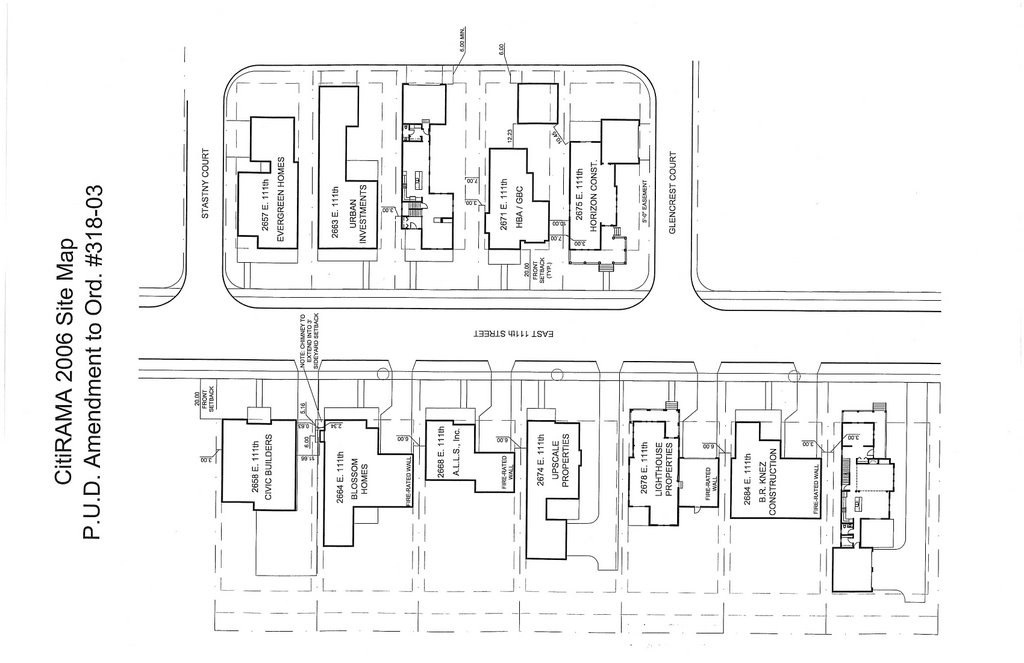
This is an amendment to an ordinance previously passed for the St. Luke’s North Pointe Planned Unit Development for CitiRAMA in 2005. The site plan is being revised

MANDATORY REFERRALS


Ordinance No. 1069-00: (approved)
Designated the Cozad-Bates House as a Cleveland Landmark.
Landmarks Commission Chair, Bob Kaiser presented to the Planning Commission. He told everyone the building designation has been tabled since 1975. The original portion of the building was built in 1853, the rest of the building in 1872. It is of Italianate Style – probably the best in the county
Chairman Coyne opened the floor to the public.
Kathleen Crowther, Executive Director of the Cleveland Restoration Society: Expressed her gratitude to the University Hospital system for donating the property
Joan Southgate, 73 year old grandmother who walked around 350 miles retracing the route of former slaves on their route to freedom: Introduced friends associated with Restore Cleveland Hope, which includes decedents of the original land owners of the area around the house. She mentioned the name “Hope” was chosen because it is believed the word was a secret code name for the Underground Railroad.
Among others that spoke:
Chris Ronayne, Executive Director of University Circle, Inc.
Hunter Morrison, Former City of Cleveland Planning Director
Councilman Kevin Conwell – He stated that there was to be legislation to change the name of East 115th Street back to its original name, Harriet Tutman Lane

Ordinance No. 114-06:
Ordinance authorizing the sale of property as part of the Land Reutilization Program and located on East 79th Street and Hough Avenue to Eric D. Payne. [Disapprove as obsolete and no longer needed]

Ordinance No. 572-06:(approved)
Authorizes the Director of Economic Development to enter into contract with Playhouse Square Foundation to provide economic development assistance to partially finance the IdeaCenter Building located 1375 Euclid Avenue to redevelop the property.
This will further assist finding companies to move into the remaining, empty third and part of the fourth floor.

Ordinance No. 566-06: (approved)
Approved the reports of assessment equalization boards on objections concerning assessments to relay and repair sidewalks, driveway aprons and curbs.

Ordinance No. XXX1-06:(approved)
Authorized the entering into contract with Cleveland Public Art for professional services necessary to administer the City’s public art program

ADMINISTRATIVE APPROVALS

Ordinance No. 367-06:(approved)
Authorized an agreement with Norfolk Southern railway necessary for the City to install and maintain its sewer located within the railway’s property between West 41st Street and West 86th Street and to pay the railway a fee.

Ordinance No. 579-06:(approved)
Authorized an agreement with the Cleveland-Cuyahoga County Port Authority and Flats East Development LLC, for construction and financing of residential units and related commercial improvements.

SUMMARY CALENDAR

Ordinance No. 447-06: (approved)
Authorized the execution of deeds of easement granting to the Board of Commissioners of Cuyahoga County certain highway and aerial easement rights in property needed to reconstruct, repair, and maintain the Fulton Road Bridge; and declaring the easement rights not needed for public use.

Ordinance No. 448-06: (approved)
Authorized the Director of Public Service to execute deeds of easement granting to the Greater Cleveland Regional Transit Authority certain easement rights in various locations along Euclid Avenue needed in connection with the Euclid Corridor Transportation Project; and declaring the easement rights not needed for public use.

Resolution No. 463-06: (approved)
Declaring the intention to vacate portion of Bates Avenue.

Resolution No. 464-06: (approved)
Declaring the intent to vacate a portion of East 59th Street.

Ordinance No. 1992-06: (approved)
An emergency ordinance authorizing the sale of property to Lula Blevins as part of the Land Reutilization Program located on Harlem Court.

LOT SPLITS AND PLATS

833 Starkweather Avenue, owner Dave Mikolajdzyk: Proposed split of a 30’ x 140’ lot in Tremont, to create (2) 30’x 70’ parcels. (APPROVED)

Riverside Park Estates Subdivision Plat (APPROVED)

East Woodland Estates, E. 75th for Hill Place Plat (also DRC No. 06-017) (TABLED)

3600 East 59th Street - Lot Split (From 3/17/07 CPC Meeting) (DISSAPPROVED)

CLARCK-METRO BRD


CM 2006-001:
3002 Clark Avenue (north side of Clark Avenue). New Construction. 6,840 sf Autozone Store, seeking full approval

CM2006-002:
3024(a) Clark Avenue (north side of Clark Avenue). renovation of west portion of existing 35,685 sf, Retail Building. 18,947 sf. Save-A-Lot Grocery Store. Seeking Final Approval

CM2006-003:
3024 (B) Clark Avenue (north side of Clark Avenue). Renovation of east portion of existing 35,685 sf Retail Building. 16,738 sf

All three of these were combined for one presentation. The property is the former Topps (nee Pick-n-Pay) on Clark Avenue and West30th Street. The developers are going to divide the current building into two units, one will be a Save-a-Lot and the other will be a Dollar Mart. The third portion of this is the construction of a new building that will house an Autozone store.
The only issue presented to the Commission had to deal with signage. Most of the presenters agreed, including the CDC representative, the signage on Cark Avenue is overwhelming and lacks visual appeal. The current plan calls for two signs: one would hold two signs for the discount stores and the other would be a standalone for the auto parts supplier. Autozone does not want to share sign space with the other two stores. Besides, that would make the sign to high.
The commission gave approval for everything except for the pole-mounted sign, which is to be resubmitted for approval.

DESIGN REVIEW

DRC 06-019:(approved)
East 75th Street & Woodland Avenue, East Woodland Estates (aka Hill Place), Exterior Remodeling, Phase 1
This was approved and it was noted on the record that the developer had already begun the remodeling before any approval had been given. They apologized.

DRC 06-022:(approved)
2070 Circle Drive, Cleveland Clinic, Glickman Tower
This will be new construction located behind the new Heart Center. The ten-story internal glass and granite tower will house the Glickman Urology Institute on the op four floors (not including two for mechanical). The rest of the building will be designated flex space.

DRC 06-023:(approved)
West 54th Street near Herman Avenue, Three Single-Family Houses, (aka Residences of King’s Hill), Project Revisions (ref. DRC 02-207)
City Architecture designed the remodeling work.

DRC 06-014-A:(approved)
East 111th Street, between Woodland Avenue & MLK Boulevard, CitiRAMA 2006, 10 Single-family Houses (Fr 2/16/06, Design Guidelines)
Location – Developer
1. 2657 East 111th Street – Evergreen Homes
2. 2663 East 111th Street – Urban Investments
3. 2667 East 111th Street – G E Construction
4. 2671 East 111th Street – HBA/GBC Homes
5. 2675 East 111th Street – Horizon Construction
6. 2688 East 111th Street – Liberty Construction
7. 2684 East 111th Street – B.R. Knez Construction
8. 2678 East 111th Street – Lighthouse Properties
9. 2674 East 111th Street – Upscale Properties
10. 2668 East 111th Street – A.L.L.S., Inc.
11. 2664 East 111th Street – Blossom Homes
12. 2658 East 111th Street – Civic Builders
May 1st is groundbreaking with the event planned for September 9th – 18th
All houses were approved with staff recommendations.

DRC 06-024:(approved)
1800 East 105th Street, CWRU West Quad Site, Temporary Parking Lot by Cleveland Clinic.
600+ parking spaces will be landscaped, fenced in and include a run-off basin. The lot will most likely be gone by 2008

Thursday, April 13, 2006

News from Cleveland Colectivo - Inaugural Grants Announced

CLEVELAND-BASED GIVING CIRCLE ANNOUNCES FUNDING FOR
INNOVATIVE PROJECTS IN CLEVELAND NEIGHBORHOODS

The Cleveland Colectivo, a new Cleveland-based “giving circle” whose members make collective contributions to innovative projects in Cleveland, announces the four projects selected for inaugural grants: The Building Bridges Mural Project, The Westside Refugee Family Center, City Wheels, and The Tremont Urban Learning Garden. Reflecting the group’s determination to transform Cleveland, these projects, selected from more than forty applications, focus on creativity, social justice, economic development and environmental sustainability.

“The Cleveland Colectivo is a group of people committed to effecting positive change in Cleveland,” said Walter Wright, one of the founding members of the group. “We believe that philanthropy is something that anyone can participate in – not just Peter Lewis or Bill Gates. We want to celebrate the grassroots projects happening in Cleveland and help them to grow. These grants are meant to be catalytic in nature; and in some cases, they’re given to groups that might not qualify for traditional funding.”

The four groups selected for funding are:

* The Building Bridges Mural Program: awarded $3,000 for artist Katherine Chilcote’s effort to create a youth internship program in partnership with Doug Horner at St. Paul’s Community Church that will result in a mural installation at the intersection of West 25th and Detroit Avenue;

* The Westside Refugee Family Center: awarded $2,500 to implement a six-month pilot “Mommy and Me” program, enhancing offerings already available to a growing number of refugee families on Cleveland’s near west side;

* City Wheels: awarded $1,000 for grant-writing assistance to support this innovative Northeast Ohio car sharing service designed to provide a creative cooperative transportation alternative to car ownership;

* The Tremont Urban Learning Garden: awarded $750 for materials to this project in which Lucky's Coffee Shop/Sweet Mosaic Bakery will work with neighborhood youth to build a garden in a vacant lot adjacent to the coffee shop and use the locally-grown produce in food and baked goods sold at the bakery.

The Cleveland Colectivo was formed in January of 2005 and has spent the past year recruiting members, creating an organization, and soliciting proposals. Unlike traditional foundations, The Cleveland Colectivo has created a giving circle model with no formal executive director, board of trustees or overhead – except for occasional purchases of pizza and drinks. Decisions are made by consensus at monthly meetings and membership is open. Voting members contribute at least $100 per quarter and non-voting “associate” members contribute by attending meetings and volunteering. For more information about The Cleveland Colectivo, visit www.clevelandcolectivo.org.

The Cleveland Colectivo mission statement is: “Clevelanders coming together to strengthen our community through collective investments that identify and nurture innovative projects.”


Monday, April 10, 2006

Cleveland State University Project Update

CSU is moving right along with their capital improvements. The Recreation Center, Fenn Tower Student Housing, Parker Hannafin Administration Center and East Parking Garage will all open before the end of the year - The Recreation Center should be open for the new semester.

Projects Update


The latest update on currnet projects can be found here http://www.csuohio.edu/architect/status_reports/current.pdf

Current Status Notes

Recreation Center
o Interior painting of finished drywall is continuing.
o Sports Floors in multi purpose rooms are being installed.
o Mechanical, electrical, plumbing, and technology systems are being installed.
o Site improvement contractor has begun work.

Fenn Tower
o Exterior restoration at 92% complete.
o Windows are being installed, 93% complete.
o Drywall 100% complete on floors 8-19; 50% on floors basement – 7.
o Site work on east side 55% complete.
o Painting, VCT flooring, cabinetry, and door installation in the tower is 80% complete.
o Punch list items have started for some of the tower floors.

Parker Hannafin Administration Center / Hall
o Structural steel in the Administration Building is near completion.
o Roof on Administration Center to begin mid April.
o Floors and decks in the Administration Building will be complete in April.
o Excavation for Parker Hannifin Annex to begin soon.

East Parking Garage
o Elevated decks on east bay are 50% complete and are expected to be complete by April 24th.
o Slab for the west bay is scheduled to begin in two weeks.
o Structural steel for stairs and elevators will start in two weeks.
o Brick and Masonry schedule to start by end of April.

Main Classroom Stair Tower Phase 1A
o Bids received for construction. Successful combined bid by Fiorelli Construction. Currently at Board of Regents for state funding approval.

Main Classroom Plaza Build Out Phase 1B
o Completed program validation, proceeding with Schematic Design.

Student Center Phase II
o Both A/E Consultant and Construction Management have been approved. Currently entering into contract negotiation.

Saturday, April 01, 2006

Faking Places - April Fools

Blatently stolen from Project for Public Spaces
Sorry, it was too funny.

Please check out the more serious matter on a regular basis. Lots of good information.


News and Ideas from Project for Public Spaces

Feature Story:


Congressmen enjoy a test run of the proposed Thursday potlucks on the National Mall.

National Mall to Become Lunchtime Hangout for Congress

With partisan tensions running high on Capitol Hill, it appears that both sides of the aisle can still manage to agree on one thing: Hanging out together on the National Mall for good food and friendly conversation.

[read the full article]

Also In This Issue:

New Self-Help Movement Transforms the Streets of America

Auto Addicts Anonymous credited with reviving community life. [read more...]

O Canada!

Placemaking sweeps the north country. [read more...]

Let 10,000 Plazas Bloom

Texas looks south for ideas to enliven its communities. [read more...]

PPS Names Best and Worst Public Spaces in the Galaxy

From universe-spanning wormholes to neighborhood asteroid belts, here are the best places we've come across. Plus, don't miss our Cosmic Hall of Shame. [read more...]

Torino Converts Olympic Spaces into Summertime La Dolce Vita

"Sure, it was easy to get people to come out in public in the dead of winter, but once the snow melts - what is there for them to do?" [read more...]

PPS Staffers Branch Out as Fashion Models for J. Crew

"It's sort of weird. I never envisioned myself as a fashion model." [read more...]

New York Round-up

Forest City Ratner drops arena proposal for Brooklyn's Atlantic Yards. Plus, New York's first Bike and Walk to Work Week, a surprising announcement from IKEA, and a change of plans for the Bronx Terminal Market. [read more...]

Introducing Sodpavers...

...the green alternative to wide swaths of asphalt. [read more...]

Past Issues of Faking Places:

April 1, 2005

Fearful of losing their long dominance of the streets, millions of autos staged massive park-ins in public spaces around the nation to protest pedestrians and alternative modes of transportation. [read more...]

April 1, 2004

Under the influence of PPS, Wal-Mart abandoned mega-stores in favor of locally-owned, downtown shops. [read more...]

Monday, March 27, 2006

Cavaliers are moving to Independence

This was just released by the Cavaliers on their web page.
Although it would have been nice to have some new construction in the place of a parking lot, it is encouraging to see Mayor Jackson's economic development cooperation talked about during the State of the City take shape already.
I am impressed.

Tax-sharing plan proposed that will allow Cleveland and Independence to share income tax revenue as Cavaliers move practices to Independence

Cleveland, Ohio, March 27, 2006 – Cleveland Mayor Frank G. Jackson and Independence Mayor Fred P. Ramos announced a plan today to split income tax revenue from the Cleveland Cavaliers payroll when the team begins practicing in Independence prior to the 2007-08 season. The announcement was made at a joint news conference in the Quicken Loans Arena with Cavaliers and Quicken Loans Arena CEO Mark Stornes.

Legislation will be introduced in both Cleveland and Independence that, when passed, will allow the cities to share revenue generated by the Cleveland Cavaliers’ payroll. The Cavs currently practice in the City of Cleveland at the Quicken Loans Arena, but plan to build a new facility in Independence.

Mayor Jackson, a long-time proponent of regional economic cooperation, says that this situation is a perfect example of how cities within the region can work together to boost the economy.

“We can and should encourage businesses to locate where it is in their best interest to do so, without stealing jobs and revenue from our neighbors,” said Mayor Jackson. “This revenue sharing strategy will allow the Cavs to build a new facility where it makes sense for them to do so and allow both Independence and Cleveland to reap the benefits. I thank Mayor Ramos for his efforts and willingness to work with the City of Cleveland, and the Cavaliers organization for their commitment to building success for Cleveland and the region.”

Mayor Ramos stated, "I applaud Mayor Jackson and his staff on initiating an early relationship built on trust and cooperation between our communities. We will work together, to the best of our abilities, on the Cavaliers project to benefit both our communities and the positive economic impact it will have on each. I also look forward to working with Mark Stornes and the Cavaliers organization to build and bring their practice facility to the City of Independence."

"The spirit of cooperation shown by Mayor Jackson and Mayor Ramos has been critical in placing the Cavaliers in a position to move forward with building the best practice facility in the NBA. They have been team players, while still representing their respective communities' interests well," said Cavaliers and Quicken Loans Arena CEO Mark Stornes. "The new Cavaliers practice facility will play a very important role in the continued development of the championship-caliber culture we are committed to having. We are thankful that Mayor Jackson and Mayor Ramos have been supportive in helping devise this win-win-win equation for Cleveland, Independence and the Cavaliers."

Both Cleveland City Council and Independence City Council will deliberate over the legislation. Mayor Jackson and Mayor Ramos are both optimistic that the legislation will pass and the revenue-sharing plan will move forward.

Saturday, March 25, 2006

Cleveland Planning Commission Report - Friday, March 17, 2006

Cleveland Planning Commission Report, March 17, 2006

Call to order – 9:04 AM

Roll Call –

Present:
Bob Brown
Joe Cimperman
Lillian Kuri
Gloria Jean Pinkney
David Bowen
Larry Lumpkin
Rev. S. Small

Absent:
Tony Coyne

Approved March 3rd minutes

Legislation (all passed)

Ordinance #311-06
Improvement of the Department of Finance facility, specifically the Print Shop portion of it, at 1735 Lakeside Avenue
Ordinance #376-06
Authorization for the Historic Warehouse District Development Corporation to encroach into the public right-of-way by installing hanging flower baskets on every historic light pole
Ordinance #xxx1-o6
Legislation to be introduced to allow a lease agreement between the city and Lake Shore Electric Railway to store a trolley collection inside the Dock 32 Warehouse for 18 months (introduced on March 20th).

They are currently working to raise funds for construction of a new storage and viewing at the end of the Waterfront near the Municipal Parking Lot.

Mark R (from Marous Brothers – I forget his last name): The cars have to be off of the Olmstead Falls property by mid-June or the current owner ill lose the trains to the new owner.

Jim Cox (Flats Industry Association, Executive Director):
Submitted letter to the Commission
“Today I am here to advocate for the ‘highest and best use’ for Dock 32 at the Port of Cleveland. Dock 32’s last tenant was FedMar Terminals, which paid $175,000 annually in rent as well as more than $100,000 in dockage and wharfage fees. FedMar handled 100,000 tons of cargo valued at $35 million.
The Port, through its Memorandum of Understanding with the previous administration, surrendered its lease of Dock 32. Returning the dock to the city so that the property would become an integral part of the City’s “Lakefront Plan.’
Using this invaluable dock wharf and warehouse space for the storage of trolleys, even if only or 18 months, is not the ‘highest and best use’ of this maritime infrastructure.
As the …Northeast Ohio Research Consortium’s Jan. 2006 Brief … indicates, the predominant workforce segment of the economy of Cleveland and Northeast Ohio is still manufacturing. To retain and reinforce that industry and the many jobs it generates, Flats Industry believes Dock 32 should be restored to the highest and best use, even if only for 18 months. It should not be another parking lot generating zero revenues for the city. Flats Industry believes Dock 32 should be restored to the highest and best use, for maritime activity, even for a minimum of 18 months.
Maritime use will guarantee jobs and will guarantee a substantial income to the city’s general fund. Thank you.”
Bob Brown:
The lease was terminated by the City with an understanding that there would be no problems

Mark:
The trolley will remain inside… there should be room on the outside of the warehouse for emergency storage.
There is a plan B that will utilize storage at a warehouse at Mitel Steel – not our first choice… would not be accessible to those who want to see the trains.

Jim Cox:
The Steel needs to be inside a warehouse, not outside.

Resolution #319-06
Declaring the necessity and intention to appropriate property for the public use of repairing and resurfacing a portion of St. Clair Avenue

Administrative Approvals (all passed)

Ordinance #300-06
Regarding the construction of maintenance yard wash-out pits

St. Clair/Superior BRD
1. The Year of the Dog – St. Clair/Superior neighborhood art installation project presentation. Previously passed by the commission - see here.
2. Lot Split – 3600 East 59th Street (tabled)

Design Review

1. DRC 06-017
East Woodland Estates-Hill Place Phase 1 Remodel (w/d)

2. DRC 06-018 (approved)
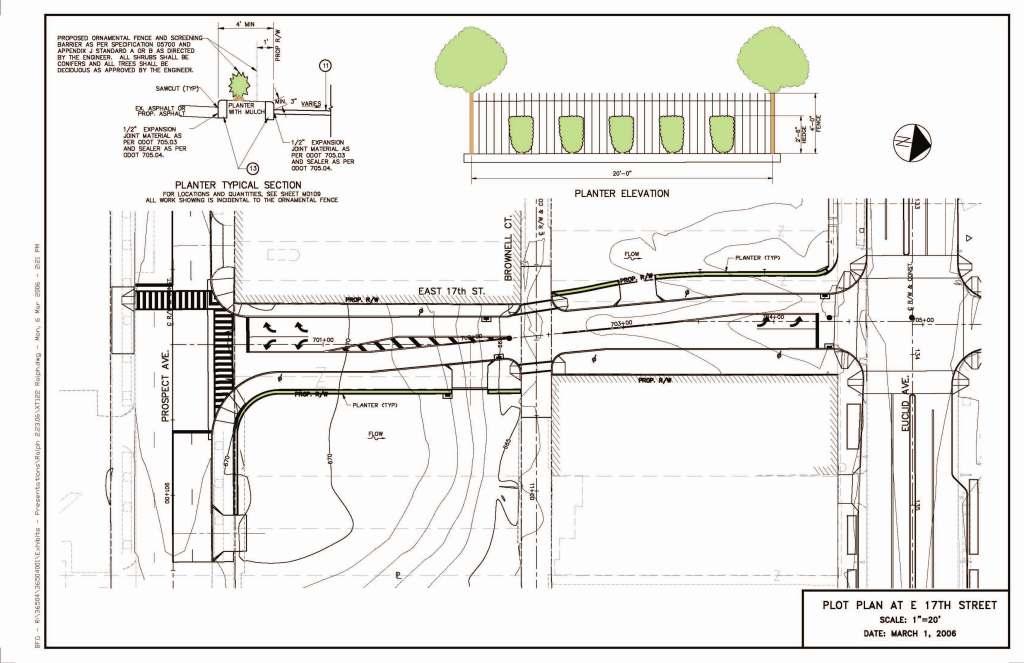
East 17th Street Extension, Streetscape Design
415’ of new roadway that will extend East 17th Street at Euclid south to Prospect Avenue. Construction will begin in April and will end in August. It is part of the Euclid Corridor Project. There will be ornamental fencing along the parking lots with appropriate landscaping.
Kuri: There is an opportunity to visually enhance the building to the East of the new road. (Bonfoey Gallery)
Brown: There are future plans to address the appearance of the Hanna Parking Garage by City Architecture.
Kuri voiced her displeasure with the standard streetlights that will be installed.
Brown: We will contact CPP about seeing what is available in the inventory that would be more suitable.
Design Review is suggesting the placement of trees along the sidewalk next Bonfoey – the Planning Commission disagrees.

3. DRC 06-016 (approved)
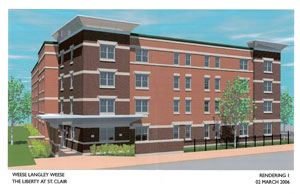
1000 St. Clair Avenue, The Liberty at St. Clair, Multifamily Supportive Housing
A joint development of EDEN, Inc. and the Cleveland Housing Network. It is a four story building located at 10000 St. Clair Avenue with 72 units ranging in size from 330 to 380 sq. ft. It is "supportive housing project for single adults in critical need of housing and in danger of being homeless." There will be a community space with kitchen, computer classrooms, multi-purpose living spaces, laundry room, case manager offices and 24-hour front desk security.

Project cost: $10,000,000
Architect: Weese Langley Weese
Construction to start in summer

4. DRC 06-013 (all but the the top of the building approved)
750 and 700 Huron Road, AT&T Buildings, Skyline and Street Level Building Identification Signs
Proposed signage with the new at&t logo or the two buildings on Huron Road. The only issue was with the logo at the top of the main building. The commission is not happy with the size and placement of the logo.
I did not have any renderings, but a little Photoshop magic can show you sort of what it would look like. (I did this in five minutes, so forgive the crudeness of it please.) The logo near the top floors of the building, in fron of the windows, is one of the proposals (without the white background and maybe twice the size)
By the end of the presentation, the commission, as well as the at&t representative all felt the best option would be to place the main logo sphere at the top of the building as is pictured in my simulation. This would give a nod to the whole superman Daily Planet concept that the building is rumored to have inspired. The rep was going to propose this to his bosses. (building photo courtesy of Clevelandskyscrapers.com)


Friday, March 24, 2006

Quicken Loans

I heard on the news this morning (according to the reporter) that Quicken Loans is looking for a new headquarters once their lease expires in Livonia, Detroit in a few years.

You can read the PD article here.

However, I looked around for some news in the Urban Ohio Forum and found a post that linked to two articles from the Detroit News, here and here, as well as a bunch more from Google news.

It is good to see the other side of the story.

For now, I am glad the new loan center will be opening soon.

Monday, March 20, 2006

Innerbelt news in Crain' Cleveland

Not the most informative aticle, but it ended like this:
Michael Armstrong, senior transportation engineer with the Federal Highway Administration’s Columbus office, said no decisions have been made on the Innerbelt. He said his office is expecting an environmental impact report from ODOT in November that will document the environmental, social and economic impact of the planned reconfiguration. It will open a public comment period and after that make a decision whether to adopt ODOT’s plan or ask the state to modify its plan. He wouldn’t put a timetable on the federal decision-making process.


Saturday, March 18, 2006

As if I have enough time!

I've had this feeling for a number of years now. The feeling that we are made to drive long distances in order to meet are basic needs. I have always lived in the city and it drives me crazy to have to go to the suburbs to purchase anything the family may need... or want. I don't mean to complain, I love driving. I enjoyed it my whole life - even as a cab driver. I just hate driving with other people on the road. Many people should not be allowed to drive. They should be made to renew their test every so many years - I would do it if I had to.
Any way... I just started another blogthat I want to use to document the things I see when I am driving (stopped... most of time).
Enjoy "View from the Dashboard."

I may at some point open the blog up to other drivers who want to post.

Saturday, March 11, 2006

Cleveland Planning Commission Report – Friday, March 3, 2006

Cleveland Planning Commission Report – Friday, March 3, 2006

Call to order – 9:12 AM

Roll Call –

Present:
Bob Brown
Tony Coyne
Joe Cimperman
Lillian Kuri
Gloria Jean Pinkney
David Bowen

Absent:
Larry Lumpkin
Rev. S. Small

Approved February 17th minutes

Zoning
Ordinance No 272-06: (approved)
Change the zoning on the southwest corner of Linnet Avenue and West 117th Street from General Retail Business District to a Multi-Family District.
City Planner, Michal Bosak and Councilwoman Dona Brady spoke on behalf of the project and the property owner directly affected spoke against it.
Brady:
This is a continuation of the Master Plan.
The rezoning has already been completed up to Governor.
There is a lack of parking for the business that are there now. Patrons are parking on the local side streets, blocking access to residents and the fire station in particular.
We think it would be a great place residential occupation. Especially with Halloran Park across the street.
The master plan is calling for West 117th Street to be all residential from Lorain Avenue to Bellaire Road.

Councilwoman Brady was expecting to introduce legislation for more zoning at the council meeting Monday, March 6. This will make land use more compatible with what is happening in the neighborhood. The proposed rezoning will run along the entire West 117th Street corridor from Lorain to Bellaire on both sides of the street. Of course, any properties that currently have business on them will be grandfathered in.

There was one person opposed to the rezoning. Mainly because he did not understand how this would impact his business. He owns a bar that is currently closed for renovations. As long as his bar reopens within at least six months, his business can remain.

Mandatory Referral
1. Ordinance No. 325-06: Authorizes the sale of Land Reutilization Program property located on Union Avenue to Kids Health 2020. APPROVED
(This is a Child and Family Welness Center. The Sommission stated that the title not be transferred until they see final drawings.)
(Photos courtesy of Alethea Ray, City of Cleveland)

2. Ordinance No. 164-06: Authorizes the sale of Land Reutilization Program property located on East 33rd Street and Cedar Avenue to Burton, Bell, Carr Development, Inc. (TABLED)
Summary Calendar (all approved)
1. Ordinance No. 1835-05: Authorizes the sale of Land Reutilization Program property located on East 49th Street to Scott Bibb.
2. Ordinance No. 193-06: Authorizes funding to rehabilitate parts of St. Clair Avenue between East 55th and 72nd Streets. {Interesting – this is in Councilman Cimperman’s ward and he was very surprised to hear about it… but happy nonetheless.}
Design Review
1. DRC 06-016: 10000 St. Clair, the Liberty at St. Clair, Multi-family Supportive Housing (withdrawn).
2. DRC 06-013: 750 Huron Road. AT&T Building. Skyline and Street Level Signs (withdrawn).
3. DRC 06-007: 811 Prospect Avenue, Fantasy One Night Club, Renovation and Signage.
The owners are asking for final approval for this property that used to be the site of the former Standard Theater. (approved)
From CinemaTreasures.org:
This downtown Cleveland theatre, which was sort of out of the way on Prospect Avenue, was mainly a venue for adult pornographic films, although it had shown mainstream films early in its life. The Standard closed in the mid-1980's. The theatre had shown black-oriented action films briefly in the early 1980's.
The building that exists there now has been empty ever since it was constructed in the mid 80’s The new nightclub/restaurant is expected to be open early during the week to feed business people and late night for club goers. (6:00 AM – 2:00 AM) There will be a video game arcade on the first floor and bar/nightclub on the second floor and mezzanine. The is to be decorative lighting on the outside that is to give the feeling of effervescence to those on the street.
Kuri suggested they test the lighting out first because the streetlights may drown out the special lighting, as is what happened with the lighting for Cleveland Public Art.

Fantasy One Night Club should be open by the middle of June.

Innerbelt Update:
James Haviland gave the Commission a briefing from the Community Meeting on Tuesday, February 21.

Some of the discussion from the update (everyone was talking and over-speaking each other, that I missed much of it)

Cimperman: Listening to ODOT was like watching FOX News – everything was like “TERROR AERT… TERROR ALERT”
Kuri: If the Economic Impact Study has 50% of the graphic detail as the accident graphics ODOT showed on the screen, we would have one heck of a report.
Cimperman: ODOT keeps telling us, “This is the most dangerous section of freeway in the state.” Of course what they do not say in the same sentence is that this one of he busiest sections of freeway in state as well.
Haviland: We found there are more severe accidents along the I480/I77 interchanges.
CSU is on board with ODOT, but we are not in concert.
Coyne: Doesn’t CSU gain more land in this deal?
EVERYONE: YES!!!
The conversation turned to the proposed ramp closure at Carnegie Avenue and how if the ramp is going to stay, the Juvenile Court House might have to go.
Cimperman: All of the sudden, ODOT has become the great defender of Historic Preservation
Coyne: The Courthouse is in the hands of the County Commissioners. If they put their foot down and make the judges move to the property in Fannie Lewis’s ward, the building could come down.
Haviland: Downtown Cleveland Alliance has now sent letters of concern to ODOT, Voinovich and many others. The Indians and the Cleveland Clinic are now seeing the problems that will occur with the eliminations of Carnegie and Prospect. They are beginning to make some noise.
We are hiring are own traffic engineer to do further studying.
Cimperman: I will go on record – If this plan is approved as currently stated, it will kill the city.
Coyne: We need to wrap this up for today, but let me add, we may be done with public input. We are going to have to lock some people in a room and not let them out until this is resolved.

Monday, March 06, 2006

Montreal's Mirabel Airport To Be Turned Into Theme Park

This is interesting. From AviationNow:

Montreal's Mirabel Airport, which hasn't seen a passenger flight since October 2004, will be transformed into an amusement park under a deal reached last week.

Aeroports de Montreal (ADM) and I-Parks-Oger International signed a memorandum of understanding to develop an "indoor recreational multiplex" at Mirabel covering more than 100,000 square meters. AeroDream, or Reveport in French, will be a "one-of-a-kind attraction in North America," targeting local visitors as well as tourists and business travelers.

The first phase of the project will cost C$100 million (US$87.6 million) and will be financed by private-sector and institutional funding. The facility will be built on the site of the abandoned passenger terminal. The complex will also include the administration building, parking facilities and the on-site hotel, which will be renovated. The hotel will be refurbished first and will serve as a showcase for the project. Work on the hotel is scheduled to begin by June with a fall completion target.

Conversion of the terminal is to start in the fall, with the hope of a phased opening by the end of 2007. The new park will have a giant aquarium, an indoor beach and movie theaters. The MOU calls for the consortium to sign a lease with an initial term of 25 years and two renewal options of five years each. A draft proposal has already been submitted to Transport Canada.

Mirabel opened in 1975 as a reliever airport for what is now called Trudeau Airport in Dorval. Few flights ever served Mirabel, however, and the last passenger flight landed in October 2004. The airport still has some cargo and general aviation flights.

Also found here:

French-led consortium signs on to build $300-million Rêveport recreation complex

The consortium is made up of I-Parks Creative Industries, a French firm that specializes in the creation of urban tourist attractions, and Oger International SA, the global engineering company owned by the family of slain former Lebanese prime minister and entrepreneur Rafik Hariri.
Here:
AeroDream, or Rêveport, is to be a year-round tropical park for locals and tourists alike, complete with 3-D movie screens under geodesic domes, a giant aquarium, a spa, an indoor beach and retail space.
And Here:
The sprawling facility some 40 kilometres north of Montreal was billed as the airport of the future when it was opened amid great fanfare in 1975. It cost $500 million at the time, including expropriation of dozens of farms. Passenger growth projections did not happen, so the airport authority and federal government took the controversial decision to converge all flights at Pierre Elliott Trudeau International Airport in suburban Dorval, more popular because of its proximity to the city. The last passenger traffic stopped at Mirabel in 2004, leaving only cargo and private flights.
Is this possible for Burke Lakefront Airport? Somebody contact the Cleveland Quarries people in Amherst.
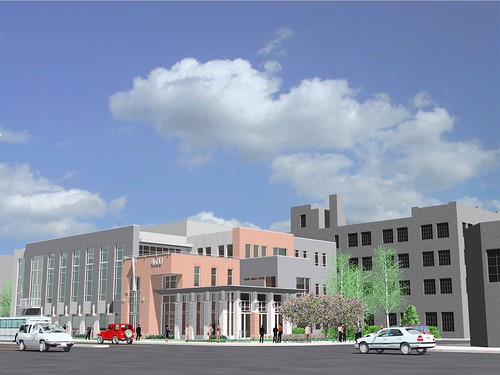
Saturday, March 04, 2006

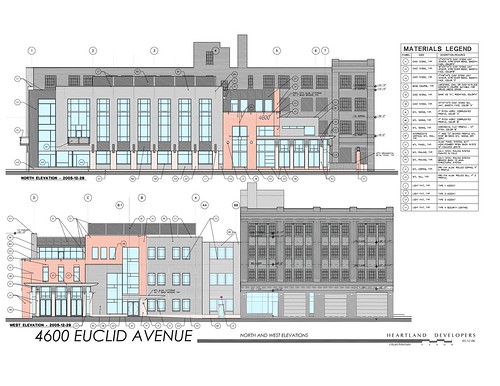
4600 Euclid Avenue

Reported in the February 3rd Planning Comission Report, there will soon be new construction a the site of a building that burned down during rehab. This is near the Agora Theater - right next door. These are a an elevation and a conceptual rendering of the building. Expect this conceptual to be pretty much right on, since Paul Volpe, et al, asked for final approval from the Commission.


(I keep forgetting to do this. Apologies) Photo Credits: City Architecture - 2006


Stay tuned for this weeks Planning Commission notes... probably after Wednesday as I have a midterm to study for.

Thursday, February 23, 2006

This a test

Ok, besides adding a bunch of nonsense to the first column in my template (tell me if it is a waste of time and I may get rid of it) I am trying out this new mac desktop widget to post this.

By the way, I want to thank everyone who gives a crap about what is going on in the city for reading this... knowledge is power

Tuesday, February 21, 2006

Live Blogging from the Cleveland Innerbelt Community Meeting

This is a first for me.
I am going to try and do a live blog.

We are at Myers University.

The room is packed.
Easily over 200 people.

Bob Brown is welcoming everyone.

9:15 am

Brown is giving us a primer on the what has happened over the past few years.
(It is good to see a nice turnout by the media)
Brown: "Our hope is that we can all learn from each other at todays meeting... keep open minds... have a safe innnerbelt for the next 50, or so years."

Introduces Jim Havilan, MidTown Cleveland, Inc.

9:20

Haviland: ODOT suggested that the public give there presentation before they do (by Gordon Proctor).
The importance of today's meeting.
-Well-defined issues
-Timing, The mayor wants a resolution
-The larger community must take a position

The goal of the meeting
-present outstanding points
-allow for informed decision making
-present a solution

9:25

History of Community Concerns in the Trench
(much of what is being said now is common knowledge for those who have been staying informed over the past few years; however it is good they are going over it)

History of Community Participation
Since December 2003, the community has maintained the need to keep Carnegie and Prospect access.
Many public meetings since then.
Jul 2005, ODOT rejects community position on trench.

9:30

History of Community Compromises
-St. Clair and Lakeside ramp closures
-West 14th and Abbey
-Innerbelt Bridge
-Quigley

Unresolved Community Points of Conflict (as of November, 2005)
-Removal of Carnegie Ave exit, eastbound
-Closure of Prospect entrance nad exit
-Close current Chester exit, westbound

9:35

Haviland walks us through ODOT's Alternative Trench Configuration (No payne Avenue Connection)
"We challange ODOT on how this is a better alternative."
Possible scenarios involving special events traffic, accidents, business location/relocation.

9:44

Procedural Points of Conflict
-Incomplete Economic Impact Study (marginal, at best)
-No traffic models

Acton requested by the Community
-Convene new series of Innerbelt Trench working meeting over a 60 day period to identify a design alternative that acheives an improved innerbelt without widespread economic and community damage.

Bob Brown introduces Gordon Proctor, Director of ODOT

9:48
He is talking about all of the projects that have been done by ODOT over the past few years.
Invite for a field trip to Columbus to observe a finished project.

Access and Crashes
-Central interchange is #1 for freeway crashes statewide
-787 crashes a year
-2 a day
-Annual cost of $12 million

"Not good for the people, not good for business."

-over a third of the accidents are during the afternoon rush
-1/3 are city residents
-1/3 are county residents

Shows a nice slide with an above ground view with little dots showing where the accidents have happened over the past three years (very impressive and convincing graphic)

9:57

Regarding Prospect and Carnegie ramps
"It is like trying to fix a sidewalk in an old neighborhood with many trees."
-Walker Weeks and Juvy Court, cannot be taken due to historic designation (legalality)
-Explains what is trying to be done in regards to accomidating I-77 north and Carnegie.
-Cannot look at those two ramps witout realizing how the rest of the interchange is impacted by the inclusion/exclusion of said ramps.

10:05
Introduces Craig Hebrebrand, project manager
"Comes down to this, five years we have worked with the city and the issue comes down to solving the Carnegie Curve area... is there a solution?"
-Walks us through the area again.
-Talks about the known bottlenecks from Metro Curve, up.
-The Carnegie Curve area needs to be cleaned up in order to service the the other traffic coming from 71, 77 and 90.
-Shows November, 2005 recomendations
--Split access at Payne/Chester
--Frontage road jogs at Prospect
--Frontage road ends at Carnegie

Proposed Refinements, February 2006
-Consolidated access at Chester Avenue
-Straighten Frontage Road at Prospect
-Extend Frontage Rd to Cedar Avenue

10:17

(It looks as if the Chester ramps will remain and be improved. Nice.)
Gloria Ferris is here and pointed out to Craig, that he avoided talking about the yellow sections of the graphic, which, of course, are the proposed takings.

Back to Proctor

They wanted to have a model available with computer animation showing traffic, but there were technical difficulties... they will provide later; perhaps place it on the website. (That will be helpful.)

Urban Design and Aesthetic Enhancements
-points out the vandal fencing, the color (gray) and lack of landscaping
-shows a slide of a bridge in Dublin, Ohio and the bridges in Newburgh Hts (77)
-states these bridges are more inviting
-shows bridge in Columbus, High Street (I-670). The city found devolper who then built structures on the bridge... retail.
-In regards to economic study: there has never been an economic study done before in Ohio... this will be the first.
-ODOT does not have a history of doing it... they are doing the best they can do.

Back to Craig about economic study

10:33

Access and Economics
-shows timing w/o Carnegie and Prospect ramps
--general increases overall... (small, but still and increase)
--"No significant change in overall employment."
---existing employment 30,000
---0.2% increase = 70 jobs

Influence of Opportunity Corridor
-the corridor will not influence traffic positively or negatively
-the further away from 55th and I490, the less influence

Rap-up by Proctor

Verification of Recommendation
-ODOT to review our recommendation
-FHWA to conduct "independent" review of ODOT's recommendation

10:42

Back to Brown for comments and questions by the public

They can be directed to anyone in the room
rules:
-identify yourself
-identify who you are directing the quesation to.
-three minutes
-only discussing the trench issues

KUCINCH REPRESENTATIVE (Marty Gelfand)
-Procedural question to proctor regarding impacts
-how can you explain no impact with all of the ramp closures
--Proctor: depends on wether DC will say there is a environmental or economic impact
-when does the process start?
--it started five years ago, the formal submittals should be this year

Gerry Martin, resident
-against closing Carnegie
-wants a promise that there will be no accidents on the side streets instead of the freeway
--Proctor:crashes go down about 30%
They have not begun to study I71 yet, there will be some consolidation

Ed "Citizen" Hauser
-Submitted 13 request regarding public process
-process has been changed dramatically
-public comment period is over, yet portions of the process continue
-specifically, the bridge
-we need the reports, then we can comment - then make decisions
-reopen the process
Proctor: your emails were so numerous and detailed... we will respond
-the process has been working - over 3oo meetings
-the southern allignment is vastly more complex
-the tie-ins will impact traffic greatly
-closures could last 2-4 years, Toledo
-once the bridge is done, other freeways will have to be closed periodically
-as part of the analysis and discussion, which has been entered in the public record, the northern allignment has the least amount of impact
-a design team has been picked, there will be a signature bridge
-the report you ask for does not exist in the format you request, it will come

Mike Cheslar, Cheslar Group
-The presentation was terrific
-shocked at the lack of economic impact understanding
-the one page questionere was lacking
-how is this going to effect on our businesses
Proctor: study will show what the traffic flow will be if there is a no-build and then show what the traffic is proposed, block by block, during construction
-there has been no study before, we are doing the best we can
Cheslar: will there be other studies?
Proctor:there is no current methodology existing off the shelf that we can follow
Cheslar: There studies all over the country that we developers use regularly
Proctor: Yes there is if you are involved in office building

Gloria Ferris, Old Brooklyn
-Comment about calling this "The Trench"
-happy to see Proctor addressed the visual aspect of this
-what gaurantee do we have that design/aesthetics will be done
Brown: The city will gaurantee that it will be addressed
-an aesthetic committee is being assembled to follow up on these issues
Ferris: what about the cost
Proctor: many of hte things will be done anyway, the cost to make them visually pleasing cost very little
-federal enhancemnet funds
-encourage NOACA to take part in these discussions

Robert Bostwick, architech
(missed the question)
something about the retaining walls
Proctor: we will share the cost in any widening/retaining wall issues
Bostwick: A sincere proposal will show that you are interested in the trees as well as the sidewalk
Proctor: are you aware of the Shoreway Project? blah, blah... ODOT has provided most of the funding for this and other local projects that do not make the freeway any better, show that we are offering goodwill, blah,blah
Bostwick: what can be done to the innerbelt to not only enhance safety, but help the local economy
-we should take Havilands suggestion to take a 60 day break to study this
-there other solutions that we have not thouhgt about yet
Applause

John (?), Blonderhome(?)
local business owner
-his employees use the innerbelt
how is the new setup going to save time for people from our location, 40th and propect
Craig: the savings are on overall trip
-there may be some waiting at traffic lights, but the overall savings from the innerbelt travel to local businesses will be decreased
John: I am suspicious of you numbers

Phil Pavarini, Tremont West Board Member
When will there be a meeting so the citizens can attend - evening
Brown: some of our most effective meetings have been in the neighborhoods, not the big ones like this
Craig: concurred, we will continue to listen
-FHWA will continue to listen
-we will have some more evening meetings

11:15

Jim Volk, Cleveland Indians
-appreciates this type of gathering and the local CDC efforts
-for the most part this is a good plan
-i would really like to take another look at 90... 40,00 fans, plus Quicken and theaters...
i think the current plan, although an improvemnet, is still flawed
-homeland security issues, do not see how this plan addresses this

Joe Cimperman, Coucilman
there has been six years of study plus w6 weeks of economic study, surprised to hear that this was your first
-when will it be done?
-who is going to pay for the maintainance of the marginal roads
-we ask that ODOT address that
-agrees with the 60 day cooling off period
-is there a concensus about this
-the conty may have some input about JUVY
Proctor: it is a given that we will do the 60 days... and up until the end of the year
- we have not maintained roads like this in the past, but will discuss with the city

Mark Leonard, Dodd Camera
-there needs to be an additional way to exit the freeway in case an exit is missed, otherwise you will end up on the other side of the river
-Juvy, questions the historic relevance of the building
Brown: it is not he use of the historic building, it is the architectual significance

Tom, Gateway
Discussed some historic issues with other buildings and preservation issues that have come up

Chris Bongorno, Planning Student
-concerned about the streetlevel traffic
-concerned about the possible 30 plus buildings that will be taken
---Artcraft
-these taking will hurt the image of the city
Brown: the city agrees that we have to do everything possible to make sure these building are saved
St. Clair/Superior: have asked ODOT to relook at some of the allignments issues with some of the buildings
Craig: We looked at takes conservatively
-there are some that we may not need
-some of the impact will only involve some of the parking lots associated with building

Frank Porter, Central Cadillac
-Greatful he has been involved with all discussions
-after spending all of the money we spent on remodeling... it will be more difficult for customers to reach us.
-compared this proposed closing to closing harvard/271 exits and trying to get to brainard
-to the representative from FHWA, is there rome for compromise
FHWA: (did not know he was here)
-this is the type of thinking we like to see... discussion
-is everyone going to get what they want, no
-in the end, this will be the most balanced
-there is room for compromise
-we cannot let special interest keep us from oour objectives: safety, access and congestion
-there is room for compromise, but we cannot promise Carnegie will remain open
Proctor: if we could keep these two exits open, we would. but the traffic studies and animation shows that traffic stops on the freeway when either one of these exits remain open
-the physics of it will not work
Jim Haviland:
-on the issue of compromise, we have proposed a a different configuration that would take Juvy , but allow for a better configuration
Proctor:
-we feel legally handtied by federal caselaw, if there is an alternative where there is no taking, then we have to follow through on that precident
-we are bound legally

Steve Qua, Limo Business
-it is not an issue of the amount of time it takes to get from a to b, it is the perception
-are those ramp reductions going to address this
-economic study question: will this allow for your business to grow?
-that question does not exist
-Can you organically grow, if the customer perceives that there is an negative change

Bill Beckenbach, Quadrangle
-concerned with the truck traffic as it effects tri-c, post office and hospital

John Cleff, Cleveland Clinic
-we are responsible for as much of the congestion as anybody
-it is important that we maintain a front door and a back door to our facility
-Euclid Corridor will reduce some of that access
-we are only to continue to grow, this must be realized

Ed Hauser
-back to public process
-i am looking for answers
-i take the lack of answers as an insult personally
-there is a 14 step public process that has been broken
FHWA: the person you need to reach is Kappka in DC
-I am aware of your concerns
-we are trying to address your concerns
-you asked about the documentation, we are addressing it
-the decisions are not final until we have finished going through the process
-the January deadline will be extended (wow)
-please do not feel like you are being ignored

Hauser:
-the bridge has been decided on and that is the part that has been decided on.
FHWA: that desicion has not been finalized (wow, again)

Terry , Business Owner
(missed question)
something about timeframe for property aquisition
Craig:
case by case until

Bob Brown:
Than you and good bye


(Comments anyone?)