Tuesday, March 27, 2007

"Cuyahoga County Commissioners to Determine Fate of Breuer Tower"

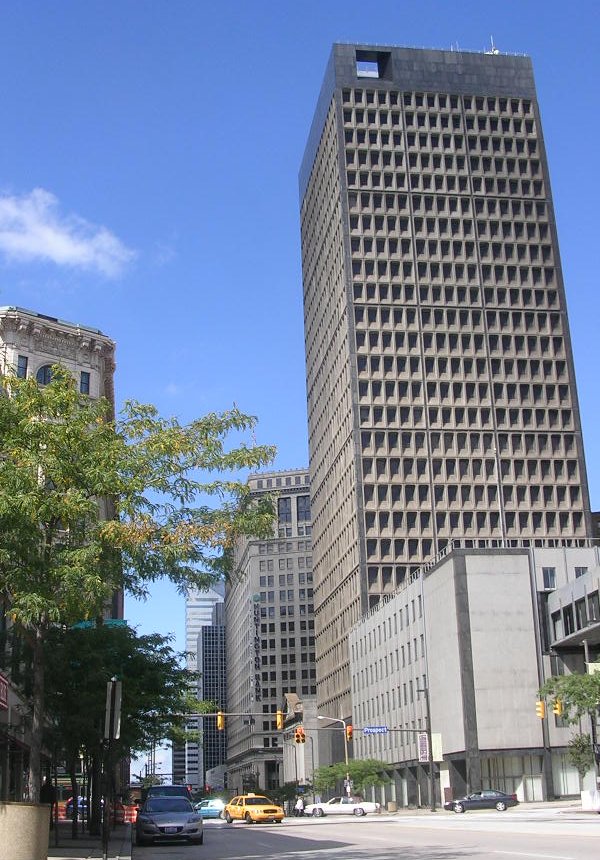
Big news coming up this week regarding the fate of the Marcel Breuer tower by the Cuyahoga County Commissioners.
(Photo of the Breuer towers as they were suppose to be built - ClevelandSkyscapers.com)

This was posted on the Urban Ohio forum and originally from the Cleveland Chapter of the American Institute of Architects:
"AIA Cleveland Urgent - Advocacy Bulletin"

Cuyahoga County Commissioners to Determine Fate of Breuer Tower

The Cuyahoga County Commissioners will be discussing the demolition of the Marcel Breuer designed Cleveland Trust (Ameritrust) Tower at it's next meeting at 11:30 AM on Thursday, March 29, 2007 at the Board of Cuyahoga County Commissioners Chambers, 1219 Ontario Street, 4th Floor.

All AIA Cleveland Members are invited to attend the meeting and express their views on this matter.

Over the course of the last several months, AIA Cleveland's Executive Board and Committee on Historic Resources has urged the Commissioners to reconsider demolishing the Tower and has called for them to conduct a comprehensive feasibility study of adaptively reusing the Breuer Tower for the new County Administration Center.

If you cannot attend, please call or e-mail your position on this important matter directly to the Commissioners before Thursday's meeting. Their contact information is as follows:

Commissioner Jimmy Dimora
Phone (216) 443-7180
CNJCD@cuyahogacounty.us

Commissioner Peter Lawson Jones
Phone (216) 443-7182
CNPLJ@cuyahogacounty.us

Commissioner Timothy F. Hagan
Phone (216) 443-7181
CNTFH@cuyahogacounty.us

AIA Cleveland Statement

Cleveland, Ohio, January 30, 2007 - AIA Cleveland, a Chapter of the American Institute of Architects, urges The Cuyahoga County Board of Commissioners to preserve and renovate the Cleveland Trust (Ameritrust) Tower.

Designed by the pioneering modernist architect Marcel Breuer in 1971, the tower's prominent location, noteworthy design and contribution to downtown Cleveland's skyline, make the building potentially eligible for listing in the National Register of Historic Places. As stewards of the built environment, it is our community's responsibility to ensure that significant examples of modern architecture like the Cleveland Trust Tower endure for future generations.

Furthermore, AIA Cleveland encourages the Commissioners to undertake a comprehensive feasibility study of adaptively reusing the Breuer Tower for the new County Administration Center. This study must thoroughly analyze the overall project development costs to the tax payers of Cuyahoga County and definitively justify the decisions made by the Commissioners. In addition, the impact of demolishing the twenty-nine story structure must be carefully considered from an economic, environmental and sustainability perspective. This study, coupled with a creative and transparent design process, will determine if and how the existing building can best meet the County's needs.

Most importantly, we urge the County to engage the community during the decision making process so that all voices are heard on this major expenditure of public resources. AIA Cleveland stands ready to provide the Cuyahoga County Board of Commissioners with assistance and counsel in this most important matter and we look forward to a constructive community dialogue on this issue.

The same person who posted this added the following information:
The topic of the Tower in this Commissioners' meeting was news to me... check out the agenda on their webpage (http://bocc.cuyahogacounty.us/) and note Item 23c where the Commissioners will vote on the abatement and demolition of the Tower contract going out to bid. From what AIA's release indicates, the Commissioners will hear statements from the public for the Tower's future.

The meeting is on Thursday at 11:30 am in the Commissioners' Chambers at the County Admin Building on Ontario and Lakeside.

Which was then followed by another member who posted the following:
The commissioners are going to design review on Thursday afternoon to ask to demolish two other buildings (I believe they are the one immediately east of the rotunda and the ungly shorter gray building on Prospect)

There is a local blog that has a plethora of information regarding what has been happening with the tower, including a copy of a flier making the rounds around town. From the Design Rag:

Taxpayers Against Breuer Tower Demolition

This tri-fold brochure from "Taxpayers Against Waste" was sent to The Design Rag and has recently been circulating around Cuyahoga County (I apologize for any difficulty in viewing):


Tuesday, February 13, 2007

New leadership for ODOT

It looks like the standard MO for ODOT will be changing sooner rather then later. According to a press release through Hannah News Wire, the new ODOT head, James Beasely, will be pursuing a more sustainable approach for Ohio's transportation projects. (See highlighted comments below.)
What this means for Cleveland and the Innerbelt project remains to be seen. Stay tuned...


Strickland Pick Augurs Policy Changes at ODOT
Hannah News Wire

The governor's office has maintained a general position of neutrality about many of the recommendations from his transition team review of state agencies, but an announcement Monday would appear to signal a new policy direction atthe Ohio Department of Transportation.

Gov. Strickland said longtime Brown County Engineer James Beasley, who happened to have served as transition team coordinator for ODOT, will become the department's new director effective March 5.

"Jim understands that an efficient and reliable transportation network contributes to and enhances economic growth," said Strickland of his 30-year acquaintance. "I am confident that he will not only be a tremendous leader in developing and maintaining safe roads for Ohioans, but will guide the department in a way that helps create jobs."

Strickland's comment points back to recommendations in Beasley's ODOT transition team report, which among other conclusions indicated the department would have to consider additional payroll cuts of one and a half percent along with other reductions to offset rising fuel and material costs and dwindling federal funding. Staffing cuts alone could save ODOT $70 million through 2010, noted the report.

Beasley's report said fiscal soul-searching would also be necessary to realign priorities around "multi-modal" transportation facilities and away from a limited focus on Ohio's primary arteries. "ODOT changed its name many years ago, but many believe it still thinks of itself as a highway department," noted the report. "ODOT needs to embrace a multi-modal economically driven project selection process that serves all of Ohio. This process needs to realize that land use patterns are a direct result of the transportation system serving them. Planning and decision making should be weighted toward containing urban sprawl."

The statement echoes that of Executive-in Residence Thomas Bier of Cleveland State University's College of Urban Affairs, who brought a significantly different perspective to testimony before the Eminent Domain Task Force last year. He said transportation and land-use practices would continue the erosion of not only Ohio's major cities but also its first- and second-ring suburbs.

"State government aggravates the situation by facilitating and promoting the development of new communities (by, for example, widening highways and building interchanges, which are powerful boosters of development) and then disregarding the deleterious effects on old communities ...."

Beasley's report offered one solution to the problem:

"Thought should be given to creating an integrated network of multi-modal facilities that seamlessly links Ohio's citizens, businesses, railways, highways, and port facilities into the most efficient transportation system possible. Ohio can be a premier gateway to international commerce and a hub for the nation's freight."
The report said state projects under ODOT would need to work with local mass transit to make this vision a reality.


As to questions over the state turnpike that became prominent in the 2006 gubernatorial election, transition team recommendations noted that, "the general consensus of stakeholders is that the turnpike is well run and provides an important transportation link in northern Ohio."

"Businesses are in business to make money," noted Beasley's report. "The only way to make money on the turnpike, if privatized, is to raise tolls or lower operating costs. Neither of these scenarios is good. But, if this would be a logical outcome, why can't the public sector do it and realize a profit?"

The 57-year-old Beasley will bring more than three decades of experience in transportation planning and construction to the various issues facing ODOT. He has served as Brown County engineer since 1980 and was previously the county's deputy engineer between 1975-1979. He served as the sole proprietor for Beasley Engineer and Surveying between 1975-1984 and worked for the Ohio Department of Natural Resources from 1973 to 1975. He graduated from The Ohio State University in 1972 with a bachelor's degree in civil engineering and earned his master's degree in hydraulic and hydrologic engineering OSU in 1973.

Beasley has also served two separate terms as vice chair and chair of the District 15 Ohio Public Works Committee. He has been awarded a life membership by the Township Trustees Association of Brown County and has received an Awardof Merit for Outstanding Accomplishments in Resource Conservation from the Brown County Soil and Water Conservation District. In 2000, he was recognized by ODOT for Covered Bridge Preservation.

He resides on a farm outside Georgetown with his wife, Alta.

"I am eager to work with our state's various regions and cities to ensure that all Ohioans have access to a quality, statewide transportation system," said Beasley. "This cooperation is absolutely necessary to ensure that economic development and job creation in every part of the state remain key priorities of ODOT."

Subject to the advice and consent of the Ohio Senate, Beasley will earn an annual salary of $124,758 as the state's new transportation director, the same amount as former ODOT Director Gordon Proctor.

Wednesday, February 07, 2007

Cleveland City Council passes West Shore Corridor resolution

North-east Ohio is one step closer to seeing commuter rail on the west side of Cleveland and the western suburbs thanks to All Aboard Ohio.

P R E S S R E L E A S E

FOR IMMEDIATE RELEASE CONTACT: Ken Prendergast
Feb. 7, 2007 (216) 288-4883 or (216) 986-6064

Cleveland City Council passes West Shore Corridor resolution

CLEVELAND -- At its regular meeting Monday, City Council unanimously passed a resolution calling on the Ohio Congressional Delegation to provide $1.5 million in each of the next two federal fiscal years for an alternatives analysis of potential transportation improvements in the West Shore Corridor.

If the funding is provided, a variety of transportation improvements between downtown Cleveland, the West Shore suburbs, downtown Lorain and possibly beyond will be weighed to determine their costs and benefits. Potential impacts on economic development, access to jobs, plus natural and built environments will be measured. A public involvement process will be an essential part of the analysis.

Transportation improvements could include adding commuter rail, expanding express bus service, restructuring existing bus routes, providing more hiking/biking paths and enhancing the existing roadway system. Sub-elements could feature transit-oriented development around stations, better transit waiting environments, adding quiet zones to the existing Norfolk Southern rail line and more.

Once the options for improving transportation in the West Shore Corridor are analyzed, a preferred alternative may be selected by the region's stakeholders and funding may be sought to implement it.

All Aboard Ohio, a statewide nonprofit association, thanked City Council for passing the resolution. Special recognition goes to Ward 15 Councilman Kevin Kelley, chair of the Aviation & Transportation Committee, for introducing the resolution. Additional recognition goes to council members who joined Councilman Kelley in sponsoring the resolution -- Anthony Brancatelli, Patricia Britt, Joe Cimperman, Roosevelt Coats, Kevin Conwell, Brian Cummins, Martin Sweeney and Matthew Zone.

"I gratefully appreciate council's passage of this important resolution," said Ken Prendergast, All Aboard Ohio's director of research and communications. "It sends a clear message to Congress that maintaining access to jobs in the West Shore Corridor is of paramount concern to City Council. Whatever transportation improvements result from this analysis should seek to enhance Downtown Cleveland's prominence as the region's main employment center."

"The region needs to be vibrant and connected," said Councilman Kelley, who favors commuter rail. "These goals would be served by regional commuter rail. While I would like everyone in the region to live in the city of Cleveland, it's very important that people at least work in the city of Cleveland."

"What the resolution is calling for is a better stewardship of precious resources," added Councilman Cimperman, whose ward includes downtown Cleveland. He also chairs council's Planning Committee. "Whether it's laying less asphalt or connecting more people to our venues, to me this is about the future."

"We need to be creating alternative methods of transportation that won't be increasing our carbon emissions," said Councilman Zone, chair of council's Public Utilities Committee. "Adding commuter rail is a win-win situation. It will help Cleveland be a more desirable place to live."

The use of federal planning funds for the West Shore Corridor was authorized by the most recent federal surface transportation law, passed in 2005. Then-Congressman Sherrod Brown (D-Lorain) worked to ensure the authorization was included in the surface transportation law.

END

Saturday, February 03, 2007

October 6, 2006: Cleveand Planning Commission Summary

Ok, I've been putting this off for a while. I will now attempt to get caught up on the Planning Commission summaries. Not all of them will be as detailed as others since I did not go to all of them (school, family, etc.), but I do have most of the agendas.
Let the amusement begin.
***************************************************

Called to order: 9:10 AM

Present:
Bowen
Brown
Coyne
Cimperman
Lumpkin
Pinkney
Small

Absent:
Kuri

ZONING (all approved)

1.Ordinance No. 1549-06: Changes the Use Districts of parcels bounded by Deise Avenue, Maxwell Avenue, Aspinwall Avenue, East 140th Street and including portions of Cobalt Avenue and Saranac Road from Semi-Industry and General Industry to Residence Industry. Tabled on September 15, 2006.

The change will better reflect the current land uses and prevent inappropriate uses (heavy industry, outdoor storage, hours of operation) mixed in with the residential fabric.

2.Ordinance to be introduced XXX1-06: To change the Use District of a parcel of land on the south side of Franklin Avenue from General Industry District to Multi-Family Residential District.

This property is located at 8001 Franklin Avenue near the Painters Loft and is currently vacant. A representative from Ryser Properties was present to introduce plans for 15 units (2 and 3 story) of housing. The approval of this zoning change will them to submit an application to Clean Land Ohio for remediation funds. Jeff Ramsey from Detroit/Shoreway was present on behalf of Councilman Zone who is in favor of the change.

3.Ordinance to be introduced XXX2-06: To change the Use District of a parcel of land on the south side of South Marginal Avenue near East 55 th Street from a General Industry District to a General Retail District.

This was in regards to the former Howard Johnson hotel south of the East Shoreway. The new owner anticipates building luxury condos with assistance from Marous Brothers. They would use the existing building and add balconies to each of the proposed 7o units. They are still in discussion on the feasibility of adding a restaurant to the ground floor. The owners, Bapaz Real Estate, originate from New York and have had successful developments there. The presented a letter from Councilwoman Pierce-Scott in support of this project. (Read Crain's Cleveland article here.)

MANDATORY REFERRALS (all approved)

1.Ordinance No. 1278-06: Declaring the property located at 1570 East 105th Street blighted premises and authorizing the Director of Community Development to acquire the blighted premises and sell the premises to FEDCO Services, LLC.

Part of the Veterans Administration expansion project. Appraised at $30,000. Construction to Begin late 2007 - early 2008.

2.Ordinance No. 1364-06: Declaring the property located at 3509 East 120th Street blighted premises and authorizing the Director of Community Development to acquire the blighted premises and sell the premises to KidsHealth 2020.

Will assist residents from birth to age 25 in the Mount Pleasant neighborhood.

3.Ordinance No. 1446-06: Authorizing the acquisition of certain easement interests along East 115th Street and Euclid Avenue as part of the Euclid Corridor Transportation Project.

4.Ordinance No. 1449-06: Authorizing a permit to the United States General Services Administration to encroach into the public right-of-way at the Anthony Celebrezze Federal Office Building located on Lakeside Avenue and East 9th Street by installing, using, and maintaining Federally mandated security devices for “stand off” and “crash” protection of the facility.

5.Resolution No. 1468-06: Declaring the intent to vacate a portion of West Lakeside Ave. N.W.

6.Ordinance No. 1470-06: Relating to restrictions on location of stables, poultry enclosures and other enclosures.

7.Ordinance No. 1548-06: Authorizing the lease of certain property to Community United Head Start and Day Care, Inc. for a term of one year, with five one year options to renew, at the Earle B. Turner Recreation Center located at 11300 Miles Avenue, for the purpose of operating a day care.

8.Ordinance No. 1576-06: Authorizing the Director of Public Utilities to apply for and accept grants from various entities to implement the Security Improvement Project; authorizing the Director to apply for and accept grants from the Ohio Emergency Management Agency for security improvements to the Baldwin and Crown Water Treatment Plants in conjunction with the Security Improvement Project.

9.Ordinance No. 1577-06: Authorizing the sell of City-owned property no longer needed for public use located at the east corner of Huron Rd. and East 4 th Street to System Property Development Company, Inc. and authorizing the Director of Community Development to cause payment to System Parking Development Co., Inc.

ADMINISTRATIVE APPROVAL (approved)

1.Ordinance No. 1439-06: Authorizing a Lease Agreement with Business Aircraft Center for office space at Cleveland Burke Control, for the period of one year with a one year option to renew.

SUMMARY CALENDAR (all approved)

1. Ordinance No. 1960-05: Authorizes the sale of property as part of the Land Use Reutilization Program located on Superior Avenue to Louis Lee.
2.Ordinance No. 1462-06: Authorizes the sale of property as part of the Land Use Reutilization Program located on East 88th street to Jeannette Relaford.
3.Resolution No. 1468-06: Refers to the vacating of a portion of West Lakeside N.W.
4.Resolution No. 1578-06: Refers to the vacating of a portion of Stuber Court N.E.
5. Ordinance No. 1583-06: Authorizes the application to the One Public Works Integrating Committee for state funding for the Cornell Road Bridge, Woodland Avenue/Kinsman Road, East 30th Street, and Bellaire Road rehabilitation Phase II Projects.
6. Ordinance NO. 1585-06: Changes the name of East 117th Street between Durant and Whitmore to Leonard B. Jackson street.

Broadway BRD (approved)

1. BC 2006-008: 6401 Broadway Avenue - Demolition request for former mechanics Auto Care building.

This provide access to the Rails to Trails project that is behind the proposed demolition. the land will be graded and seeded.

2. E185 2006-003: 972 East 185th Street - Demolition of existing garage and construction of freestanding bank building.

LOT SPLIT (approved)

4318 Orchard Avenue, Owner-Occupant Eugene Pallas

DESIGN REVIEW

The West Shoreway Project Update.

Thursday, January 25, 2007

Change for Change

Cleveland Colectivo Friends,

It is our pleasure and honor to personally invite you to "Change for Change," the Cleveland Colectivo's very first fund-raising event. The Cleveland Colectivo is a "giving circle" that was founded in 2005 and is now in its second year of funding innovative community projects.

The focus of the event is an auction. Artists from around the region are creating and donating what we are calling "Social Change Banks," an idea that builds upon the simple "change bank" that many of us grew up with: saving our pennies, nickels and dimes for a year before donating them to an organization in the community. A social change bank links the act of an individual saving money to the mission of the Colectivo: Clevelanders coming together to strengthen our community through collective investments that identify and nurture innovative projects. Ultimately, each social change bank will be auctioned off and 100% of funds raised will go directly to the 2007 grantees of the Cleveland Colectivo.

We feel your presence at this event is very important because of your dedication to community issues. This event will be a fantastic opportunity to both meet new people and reacquaint yourself with familiar faces who believe in Cleveland and its surrounding communities. Won't you join us? Food and beverages will be provided. In addition to the auction funds, 10% from the sales of all regular gallery items will go to the Colectivo and its 2007 grantees!

The event will take place on Saturday, February 10th from 7-10 pm at the Local Girl Gallery at 16106 Detroit Avenue in Lakewood. For complete information on the Cleveland Colectivo, visit www.clevelandcolectivo.org. Thank you for your time and we look forward to seeing you on February 10 th!

Sincerely,

The Cleveland Colectivo


Monday, January 22, 2007

Cleveland School Voucher Application Help Session


If you live in Cleveland, you might be able to receive financial help to send your child to a high-quality private school!

St. Mark Lutheran School at 4464 Pearl Road will offer a free Cleveland School Voucher Help Session to area families on Saturday, February 10, from 9am to 1pm.

A representative from the Cleveland Voucher Program will be present to answer your questions and assist you with the application process. There will also be a representative with information from the Lead Safe Living Campaign and free Child ID Fingerprinting Kits.

Please call 216-749-3545 or go to www.orgsites.com/oh/stmarklutheran for a list of what you need to bring to complete your application.

Applications are due February 28th!

Thursday, January 18, 2007

Guitarmania 2007

In October 2006, the PD reported that Cleveland would be having its next Guitarmania in the summer of 2007.
GuitarMania to return next summer
Friday, October 20, 2006
Barb Galbincea
Plain Dealer Reporter

Don't fret. After striking a chord in two previous appearances, they're set for an encore.

Giant guitars, part of United Way's popular public art project that debuted in 2002 and was repeated in 2004, will return to Cleveland streets next summer.

Details of GuitarMania are scheduled to be announced Oct. 30.

Individuals, companies and groups sponsor the 10-foot-high Fender Stratocaster guitars, which artists and celebrities then paint, sculpt or otherwise decorate.

The resulting artwork is displayed for several months on Cleveland streets and then auctioned at the Rock and Roll Hall of Fame and Museum.

The project has raised more than $1.6 million for health and human services programs supported by United Way of Greater Cleveland and for the Rock Hall's education fund.

Among past celebrity designers have been Yoko Ono, whose guitar was auctioned for $105,000 in 2002; rocker Graham Nash; actress Liv Tyler; pop artist Peter Max; and even three painting pachyderms from the Cleveland Metroparks Zoo.
The website was launched sometime ago, but not mania people knew about it. Many of the proposals are posted. It looks as if it is mostly local artist. However, there may be people up there I dot recognize.
Some of the names I am glad to see up there include:

Jim Lanza
Gauri Torgalkar
XinXin Liu
Craig Petersen*
Daniel Radke
Dan Broache
Jim BycznskiuK

Just to name a few.
You can check it out here.

Thursday, January 11, 2007

More "Innerbelt Re-Evaluation"?

Yesterday, Crain's Cleveland reported on ODOT's presentation to Cleveland City Council regarding the Innerbelt. With new Governor Strickland's replacement of all the management at ODOT and the increasingly strong public outcry, we are likely to see more "re-evaluations."

There will be a meeting in Tremont on February 1.

Inner Belt plan is being re-evaluated

By JAY MILLER

3:06 pm, January 10, 2007

The Ohio Department of Transportation continues to backpedal on its plans for rebuilding and reconfiguring the Innerbelt Freeway that serves downtown Cleveland.

An ODOT official told Cleveland City Council today that the state agency is re-evaluating the impact of the project on city streets and is planning to replace the existing bridge across the Flats with two new bridges. ODOT is responding to complaints from local community groups and businesspeople worried about the impact of the changes on their neighborhoods and businesses.

The complaints have come from businesses ranging from fast-food restaurants to the Cleveland Indians; the latter worries that the closing of some on-off ramps will make it harder for fans to get to Jacobs Field.

At a hearing today before City Council, Craig Hebebrand, ODOT’s Innerbelt project manager, stood by the plan to close several downtown exits but said the agency is considering changes that would relieve traffic at two key downtown intersections that will see additional traffic when the ramps close — at East Ninth Street and Carnegie Avenue and at East 30th Street and Chester Avenue.

“We’re not going to gridlock city streets,” Mr. Hebebrand pledged.

Mr. Hebebrand told City Council members that the stretch of freeway from the Shoreway to the bridge across the Flats on Interstate 90 — called the “trench” — has the highest level of accidents of any stretch of freeway in the state, even though it is not the busiest. He said the trench averages two accidents a day.

The ODOT plan, Mr. Hebebrand said, would cut that accident rate by closing several ramps at Broadway, Carnegie, Prospect, St. Clair and Lakeside avenues and reconfiguring the remaining interchanges at Superior and Chester avenues and East 22nd Street.

Mr. Hebebrand said any loss of jobs at companies that must relocate because their property is taken for the rebuilding or some of their business is lost will be countered by an increase in construction jobs during the 15-year construction period and by other new jobs that come to the area.

“There will be no significant change” in employment in the region, he said.

ODOT has studied the issue and estimates that over the construction period the area will lose about 37 permanent jobs but will gain 115 jobs for a net gain of 78 jobs.

One span not enough

The decision to build two bridges instead of one responds to concerns that the existing 50-year-old span across the Flats could not be rehabilitated to last another 50 years. The plan now is to build one new bridge, carrying westbound traffic, by 2015 and then build another, replacing the current bridge, by 2025.

However, comments from City Council members suggest that ODOT’s revised plan is not being well-received. During the question-and-answer session, downtown Councilman Joe Cimperman wondered what would happen if City Council declined to pass legislation that would give ODOT an approval it needs to move ahead.

Some audience observers who have a stake in the outcome of the discussion also were not satisfied with the changes.

James Haviland, executive director of MidTown Cleveland Inc., a community development group that serves an area just east of the Innerbelt, said he believes the plan still has significant flaws, particularly in the way it diverts traffic onto Chester Avenue and away from Carnegie.

“They (ODOT) have said (the plan) will increase traffic on some streets and that will have an impact on Chester,” slowing down traffic heading to east to University Circle and beyond, he said. “And Carnegie will have less traffic and it has the most traffic-dependent businesses.”

Central Cadillac, several fast-food restaurants and other businesses along Carnegie rely on traffic past their front doors for business, Mr. Haviland said.

Michael Coticchia, chief administrative officer of Applied Industrial Technologies Inc., in the past has said his company would consider moving its 300-plus employees from its Midtown building if the Prospect Avenue exit was closed.

“If Prospect goes, we will consider our options,” he said after today’s hearing.

Thursday, January 04, 2007

Colectivo Deadline Approaching - January 15

Do you have an idea that you think would make a difference in Cleveland? We'd like to help you make it happen. The Cleveland Colectivo is seeking projects to support.

The Colectivo is a group of friends, neighbors and colleagues. We pool our funds and share our energy to invest it back into projects that we see as worthwhile and exciting in Cleveland. Each member contributes to the Colectivo quarterly and together we choose projects to support. Every month we gather to discuss ideas, learn about area initiatives and organizations, network with a growing circle of members, and continue building the Colectivo.

So now we are again looking for innovative ideas in which to invest. That's where you come in! If you have a project that you would like to make a reality, take the first step—visit www.clevelandcolectivo.org and send us your answers to these three simple questions. Or send your answers to info@clevelandcolectivo.org.

1) What is your proposal?

2) How will this project strengthen our community?

3) What makes your project unique, and why are you the right person to do this?

We welcome individuals, new businesses, and community projects to participate. Grant amounts will range between $500 and $5,000, based on the number of projects selected.
The deadline for submissions is January 15, 2007. Please keep your response to one page.
Bring your idea to life, and let us help!

Wednesday, January 03, 2007

Cleveland Innerbelt Project Development Schedule

ODOT has released an update to their Innerbelt Project Development Schedule. On February 1, there will be a public meeting.

Tuesday, January 02, 2007

Cleveland Innerbelt Update - Construction to Start in 2010

The Ohio Department of Transportation released this press release today:
FOR IMMEDIATE RELEASE
ODOT ACCEPTS SUBCOMMITTEE RECOMMENDATION OF
SINGLE TOWER CABLE STAY
FOR NEW BRIDGE TO SPAN CUYAHOGA RIVER VALLEY

JANUARY 2, 2007, CLEVELAND, OHIO…The Ohio Department of Transportation has accepted the Central Viaduct Bridge Subcommittee’s recommendation for the bridge type for the new bridge to carry westbound I-90 over the Cuyahoga River Valley between downtown Cleveland and Tremont.

In October, the subcommittee reached consensus and recommended that the Single Tower Cable Stay be the bridge type built when construction starts on the new I-90 westbound bridge that will be built as part of the reconstruction of the Cleveland Innerbelt, starting in 2010.

Since October, ODOT has reviewed the subcommittee’s recommendation, the Bridge Type Study report, prepared by the consultant, Michael Baker Jr., Inc., and comments from the public and believes that the Single Tower Cable Stay is the appropriate bridge type for the new westbound Central Viaduct Bridge.

The subcommittee also recommended the adoption of design guidelines to be used throughout the bridge design process. The subcommittee will continue to advise ODOT throughout the design process for the bridge. The Central Viaduct Bridge Subcommittee is a subset of the Urban Projects Committee.

This release proves that things are moving forward despite a news report from the Plain Dealer on October 18 stating there would be a two year delay because of redesign issues. On November 9, Sun News reporter Ken Prendegast reported a clarification of the PD's story quoting ODOT project manager, Craig Hebrebrand: “I think there’s been some misinterpretation. All we’re doing is taking some time to dot the i’s and cross the t’s on two documents.”

Further proof of the ongoing progress is shown in ODOT's "Draft list of major new projects for 2008 - 2013." In this report the following time-line and dollar amounts for District 12 (Cleveland area) are listed, most of it for the innerbelt. To get an accurate portrayal of the amounts and time frame, read the original spreadsheet - my interpretation of it does not do it justice; sorry for any confusion.

(1st $ = Project Cost in millions; 2nd $ = Total TRAC Commitment in millions)

  • Bessemer Ave. - $5.9, $3.1, Extension of Bessemer Ave. to increase connectivity to I-490
  • I-71/90 - $922.0 $743.0 PDP Steps 5-8 Innerbelt Corridor
    GCRTA Park and Ride N. Olmstead, Strongsville, Westlake
  • I-71/90 - East 55th St. $14.0
  • I-71/90 - Quigley Road Connector
  • I-71/90 - Innerbelt Bridge; Grp 1 Construct new WB bridge and approaches I71 to Carnegie Curve $10.0
    • Cuyahoga River Valley Crossing - Tower and Superstructure $84.0
    • Cuyahoga River Valley Crossing - Approach piers and superstructure $118.0
    • Cuyahoga River Valley - West Approach $45.0
    • Cuyahoga River Valley - East Approach $118.0
  • Innerbelt Bridge; Advance Construction Contracts
    • Demo Cuyahoga River Valley Crossing-Foundations DEMO($20)
    • Building Demolition DEMO($13)
    • Slope Stabilization DEMO($8)
    • Relocation of Commercial Road DEMO($11)
    • Replacement of the East 22nd Street Bridge $10.0
    • Carnegie Avenue Improvements $9.0
    • Reconstruct I-77 Approach to the Central Interchange $6.0 $126.0
  • I-77/490 -
    • Reconstruct I-77 over I-490 $17.0
    • Reconstruct SB I-77 from SR 14 South $24.0
    • Rehabilitation of the Existing Central Viaduct
    • Existing Central Viaduct - East & West Approaches $7.0 $65.0
    • East 30th Street Extension $1.0
  • I-71/90 ITS - $29.7 $0.3 SPR $29.4 Cleveland ITS - Freeway Management System
  • I-77 - $90.6 $42.4 Major Rehab/$0.1 District $48.1 Add lane from SR 82 to Rockside Rd
  • US 322/I-271 - $19.1 $4.2 city/$0.6 Dist/$1.4 MPO $12.9 Upgrade interchange and improve Mayfield Rd.
  • US 6 - $76.4 $26.6 Local $51.7 Reconstruction of Cleveland's West Shoreway
  • Euclid Avenue Corridor - $247.4, $75.0 Euclid Corridor improvements
  • Lake SR 2 - $100.7 $21.5 Major Rehab $79.2 Add lane and interchange upgrade from SR 91 to Newell Creek
  • Lake SR 2 - $76.4 $18.1 M Major Rehab $58.3 Add Lane and interchange upgrade from Newell Creek to SR 44
The previous were Tier I numbers. There is a 90 day public comment period before any recommendations are given to the governor to authorize. There is also a substantial Tier II list which are projects under active development, but not guaranteed funding. Some of the projects include further funding for portions of the Innerbelt project, including Dead Man's Curve, the Cuyahoga River Intermodal Connector, the University Circle Access (Opportunity) Boulevard, and improvements of ramps servicing Hopkins Airport.

Sunday, December 31, 2006

To all of my readers in 2006...

Happy New Year 2007

Friday, December 29, 2006

'Youngstown 2010' City Vision and Plan Honored with National Planning Award for Public Outreach

Congratulations to Youngstown!

December 19, 2006

'Youngstown 2010' City Vision and Plan Honored with National Planning Award for Public Outreach

WASHINGTON, DC – At a public meeting in 2002, Jay Williams, who was then the director of Youngstown, Ohio's Community Development Department, called on more than 1,200 residents to embrace and own the city's new vision for the future: Youngstown 2010. It could very well be the city's last chance, he said, to begin reversing decades of population losses, economic declines, and increases in crime. The message was heard. Three years later, Williams had become mayor of Youngstown and residents had gone from supporting the Youngstown 2010 vision and developing the Youngstown 2010 comprehensive plan to embarking upon a city- and region-wide action and implementation plan.

Building public support for the Youngstown 2010 vision and comprehensive plan involved a far-reaching marketing and public education campaign. For this effort, Youngstown has been named recipient of the American Planning Association (APA) 2007 National Planning Excellence Award for Public Outreach.

"Youngstown has shown how to use the planning process to galvanize citizens to heed a call to action and take concrete steps towards saving their future," said Carol Rhea, AICP, chair of the APA Awards Committee. "From radio, newspaper and television coverage, to billboards, t-shirts and balloons, city officials left no stone unturned in their public outreach campaign," Rhea said.

The city's public outreach efforts involving Youngstown 2010 will be recognized at APA's National Planning Conference during a luncheon ceremony on April 17, 2007, in Philadelphia. A 30-minute video about all of APA's 2007 National Planning Excellence, Achievement, and Leadership Awards recipients will be shown at the luncheon. Also, the accomplishments of Youngstown and the 13 other 2007 awardees will be highlighted in the April 2007 issue of Planning magazine and on the APA website, www.planning.org.

"For a successful planning process it's essential to maintain a marketing strategy with an educational component," said Anthony Kobak, chief planner with Youngstown's Planning Department and Project Manager for Youngstown 2010.

The city's outreach efforts, in partnership with Youngstown State University, have been highly effective, attracting more than 5,000 people to participate in the city visioning and planning process since 2002. For example, 1,400 people attended the Youngstown 2010 kick-off vision meeting in 2002, and 1,300 people attended the Youngstown 2010 plan meeting in 2005.

To maintain momentum for its public outreach efforts, the city is calling on residents to get involved with implementing the plan at the same time it is launching a national advertising campaign to encourage new residents and businesses to move to Youngstown. Additional information is available online at www.youngstown2010.com.

For a list of all of the APA 2007 National Planning Excellence, Achievement, and Leadership Award recipients, visit www.planning.org/newsreleases/2006/ftp121506.htm. APA's National Planning Awards, considered by U.S. planners to be the profession's highest honor, is a tradition established more than 50 years ago to recognize outstanding community plans, planning programs and initiatives, public education efforts, and individuals for their leadership on planning issues.

Contacts
Anthony Kobak, Chief Planner, City of Youngstown, and Youngstown 2010 Project Manager, 330-742-8842; akobak@cityofyoungstownoh.com
Denny Johnson, APA Public Affairs, 202-349-1006; djohnson@planning.org


And also to Kevin Chastine from Ohio State University:

Kevin Chastine (graduate student)
Ohio State University, Columbus, Ohio
Kevin Chastine has shown exceptional enthusiasm for the field of planning, not only in the classroom, but through an internship, doing community service, and serving as president of the City and Regional Planning Student Association at Ohio State University. His strong work ethic led him to receive the two university planning program awards — the First Year Student Faculty Prize and the Outstanding First Year Graduate Student Award.

Typically students wait until the second year of the graduate program to begin taking studio courses, but Kevin has already participated in two studios, including work on rebuilding Mississippi gulf coast communities. He also has written articles for a university magazine, participated in a Planner's Day in School program involving sixth grade students, and raised funds to attend APA's National Planning Conference in San Antonio, Texas, in April 2006.

Here is a overview of all of the winners directly from the American Planning Association's press release:

December 15, 2006

Winners of APA's 2007 National Planning Excellence, Achievement, and Leadership Awards

The American Planning Association is pleased to announce the recipients of its 2007 National Planning Excellence, Achievement and Leadership Awards, which recognize the roles cutting-edge planning achievements and outstanding individual contributions play in helping create communities of lasting value.

Award recipients will be honored at a special awards luncheon April 17 during the APA 2007 National Planning Conference in Philadelphia, Pennsylvania. Also to be recognized at ceremonies in Philadelphia will be the recipient of the Secretary's Opportunity and Empowerment Award, which is presented each year by APA in conjunction with the U.S. Department of Housing and Urban Development. Announcement of that award is expected in January.


Daniel Burnham Award for a Comprehensive Plan (co-awardees)

Ontario Growth Secretariat's Growth Plan for the Greater Golden Horseshoe
Toronto, Ontario, Canada
This plan provides for an innovative and coordinated approach to sustainable growth and development for the greater Toronto, Ontario, metropolitan region encompassing 110 different municipalities. The backbone of the plan is how it integrates land-use planning for the greater Toronto region with $7.5 billion (U.S.) in new infrastructure investment. Provisions of the groundbreaking plan include establishing minimum density levels for development wherever it takes place; keeping a 1.8 million-acre greenbelt in the heart of the area off limits to development; and coordinating land-use and transportation decisions.

Click here for more details

PlanCheyenne
Cheyenne, Wyoming
This innovative comprehensive master plan for the Cheyenne, Wyoming, urban area integrates three distinct planning disciplines into one process — transportation planning; parks and recreation planning; and scenario-based land-use planning, urban character and urban design. Extensive use of interactive technology and the internet, along with cutting edge public participation strategies, were used to develop the plan. The plan also contains case studies from other communities and tools, ranging from incentive-based options to ordinances, to help implement the plan.

Click here for more details


National Planning Excellence Awards for Best Practices (co-awardees)

The New Jersey Smart Growth Locator
Trenton, New Jersey
The Smart Growth Locator was created in 2003 as a free, on-line, consumer-driven, and user-friendly tool to help developers and consumers easily determine areas that are identified for growth according to the New Jersey State Development and Redevelopment Plan. By typing in an address, a user of the locator can find out whether a property or site is within a Smart Growth Area; the State Plan planning area and census tract where the address is located; and what New Jersey Housing and Mortgage Finance Agency growth incentive programs would apply to that address or site.

At the same time, utility companies in the state also use the Smart Growth Locator to assess their utility financing. Over time, other state agencies are expected to use the Smart Growth Locator, enabling it to become a one-stop-shop for smart growth incentives. In this manner, New Jersey can address development in a consistent and comprehensive manner.

Protecting Florida's Springs: Land Use Planning Strategies and Best Management Practices Tallahassee, Florida
To help protect Florida's unique landscape of more than 600 freshwater springs, which has supplied potable drinking water to millions of residents, 1000 Friends of Florida has written and published the hands-on protection guide, Protecting Florida's Springs: Land Use Planning Strategies and Best Management Practice. The reference is both comprehensive and user-friendly, and is designed to encourage officials and citizens to work together to protect the state's natural springs at the same time allowing appropriate development to continue. To date five local jurisdictions where approximately one-third of the state's springs are located have taken strategies discussed in the manual and incorporated them into each community's respective comprehensive plan.

Click here for more details


National Planning Excellence Award for a Grassroots Initiative

Corridor Housing Initiative
Minneapolis, Minnesota
To help neighborhoods accept affordable, higher density housing, a proactive planning and education process is being used by the nonprofit Center for Neighborhoods in partnership with the City of Minneapolis. The Corridor Housing Initiative calls on citizens to be partners in the development process through an educational process facilitated by a neutral team of experts.

Educational components of the initiative include an interactive block exercise that allows community members to consider different housing options and test whether they are financially viable. This process helps participants recognize why greater densities are oftentimes needed to make a project feasible. The eventual goal is to create market-based development objectives and guidelines that are endorsed by community partners because they are compatible with city goals as well as neighborhood interests.

Click here for more details


National Planning Excellence Award for Implementation

Chattanooga Bicycle Planning
Chattanooga, Tennessee
Through partnerships and cooperation between public agencies and private organizations, advocates for using bicycles instead of cars to commute to work and run short errands in Chattanooga and neighboring Hamilton County have made steady progress. Since 2000, a $50,000 Chattanooga Bicycle Facilities Master Plan has been completed and adopted by 10 neighboring communities.

The plan provides a 20-year blueprint for $24 million in bicycle lane and route improvements in the region. Already $300,000 in federal Surface Transportation Program funds have been secured to create 28 miles of dedicated bike lanes and share-the-road bike routes, install bike racks on public buses and throughout downtown Chattanooga, and publish bicycling brochures and bikeway maps. There' also been a steady increase in the number of people riding bikes to work, to community events, and for recreation purposes.

Click here for more details


National Planning Excellence Award for Public Outreach

Youngstown 2010
Youngstown, Ohio
Officials in Youngstown, Ohio, embarked upon a far-reaching marketing and public education campaign to build public support for the city's Youngstown 2010 vision and comprehensive plan. Everything from radio, newspaper and television coverage, to billboards, t-shirts, and balloons were used to get the message out and galvanize citizens to support and participate in development and implementation of the plan. Since 2002, for example, more than 5,000 people participated in the city visioning and planning process. To maintain momentum, a national advertising campaign is underway to attract new residents and businesses to Youngstown.

Click here for more details


National Planning Excellence Award for Innovations in Neighborhood Planning in Honor of Jane Jacobs

Revitalization of Hannibal Square
Winter Park, Florida
Revitalization does not have to lead to gentrification as the redevelopment of Hannibal Square, a historic black neighborhood in Winter Park dating back to the 19th century, proves. The city, in partnership with its Community Redevelopment Agency (CRA), established a housing rehabilitation program to preserve existing, viable affordable housing in the neighborhood.

Other steps involve creation of the Hannibal Square Community Land Trust, which holds land in a 99-year ground lease. This allows residents to purchase quality homes at below-market rates compared with having to also purchase the land. The Railroad Residences, the first of their kind in the Southeast, are the most innovative component of the square. This portion of the revitalization effort involved replacing a dilapidated water treatment plant with a new, state-of-the-art plant and constructing affordable housing and other buildings that blend architecturally with the surrounding, upscale communities.

Click here for more details


National Planning Achievement Award for Hard-Won Victories

Octavia Boulevard and the Central Freeway Replacement Project
San Francisco, California
Spanning 16 years and requiring three local referenda, Octavia Boulevard opened September 9, 2005. The new boulevard had once been part of the Central Freeway, a double-decker structure that blighted San Francisco neighborhoods, particularly Hayes Valley, for more than 40 years. In 1989, the Loma Prieta earthquake damaged the Hayes Valley portion of the freeway irreparably, causing planners, elected officials, and community leaders to craft a new alternative — the Octavia Boulevard and Central Freeway Replacement Project.

Among the project's many collaborators and partners were the California Department of Transportation, several San Francisco City departments, the San Francisco County Transportation Authority, and the Central Freeway Citizens Advisory Committee. In spite of ballot measures alternating between support and opposition for the project, financial obstacles, and jurisdictional battles, each challenge was addressed and eventually resolved. The result is a boulevard that is the first of its kind to be built in the U.S. in 80 years. It provides regional and neighborhood access, four center lanes for through traffic, two local lanes and a parking lane, landscaped medians, and a community park at the heart of a revitalized Hayes Valley neighborhood.

Click here for more details


National Planning Landmark Award

Sanibel Plan
Sanibel, Florida
In 1976 the City of Sanibel adopted a land-use plan that has enabled the community to manage growth and development so as to not exceed the natural carrying capacity of Sanibel Island. Nine ecological zones on the island were identified and established to help planners designated appropriate land uses, intensity, and performance standards within each of the zones. The plan also led to one of Florida's pioneer growth management regulations, which allowed the city to control population growth so the island's infrastructure was not overburden and residents could be safely evacuated for hurricanes using a two-lane causeway. The growth restriction kept new housing construction on Sanibel to 9,000 units instead of 30,000 units as proposed by Lee County.

Click here for more details


National Planning Leadership Award for a Planning Advocate

The Honorable Mayor Kay Barnes
Kansas City, Missouri
When Kansas City Mayor Kay Barnes took office in April 1999, support for downtown was at a record low. Plans for an entertainment district had been scrapped and long-time tenants were leaving downtown for the suburbs. That didn't stop the new mayor from putting forth a vision for a new Kansas City.

Through strategic partnerships and public consensus, Kansas City is becoming what the Mayor envisioned when first taking office, a city with "strong neighborhoods, a revitalized downtown, and a healthy economy." Approximately $4.5 billion has been invested in the revitalization of downtown to date, including development of a $275 million Sprint Center Downtown Arena and an $850 million "Power & Light" entertainment district that includes retail, multi-family housing, and community gathering spaces.

Other changes under Mayor Barnes's leadership include expanded Rapid Bus Transit service, increased tax spending for public infrastructure, an increase in the number of people living downtown, and significant progress towards building or rehabilitating nearly 20,000 houses, including affordable units and rental housing for at-risk populations.

Click here for more details


National Planning Leadership Awards for Student Planners (co-awardees)

Michael Marcus (undergraduate student)
Cal Poly State University, San Luis Obispo, California
Michael Marcus has been interested in urban planning long before entering undergraduate planning studies at Cal Poly. At age 15, he served as a full-voting, at-large Parks and Recreation Commissioner in his hometown of Benicia, California, providing leadership to the community's first annual Youth Rights Workshop. Later, as a high school freshmen, he became student coordinator for a group of concerned citizens who joined together to save Benicia's historic arsenal district.

His enthusiasm for planning has become even stronger since then, both in and out of the classroom. Marcus's high academic marks have placed him among the top 15 percent of students at Cal Poly. He completed a planning-related internship with RBF Consulting during the summer of 2006, and participated with other students to develop the Templeton Downtown Plan, which received a 2006 California Chapter APA Planning Award. And his concerns about sustainability led him to spearhead formation of the Empower Poly Sustainability Coalition on campus.

Kevin Chastine (graduate student)
Ohio State University, Columbus, Ohio
Kevin Chastine has shown exceptional enthusiasm for the field of planning, not only in the classroom, but through an internship, doing community service, and serving as president of the City and Regional Planning Student Association at Ohio State University. His strong work ethic led him to receive the two university planning program awards — the First Year Student Faculty Prize and the Outstanding First Year Graduate Student Award.

Typically students wait until the second year of the graduate program to begin taking studio courses, but Kevin has already participated in two studios, including work on rebuilding Mississippi gulf coast communities. He also has written articles for a university magazine, participated in a Planner's Day in School program involving sixth grade students, and raised funds to attend APA's National Planning Conference in San Antonio, Texas, in April 2006.


Contacts
Denny Johnson, APA Public Affairs, 202-349-1006; djohnson@planning.org
Roberta Rewers, APA Public Affairs, 312-786-6395; rrewers@planning.org


Wednesday, December 27, 2006

Krumholz Appointed to Cleveland Planning Commission

This is what happens when big stories are announced during the last weeks of a school semester. I can't believe I missed this one. Norm Krumholz has taught me many things and has been a good mentor and friend. Krumholz is a self proclaimed "bleeding-heart liberal," and there have been many times I sat in class arguing against his opinions of "Equity Planning" as being not equitable at all - but thats a different story and I was really only opposing him for opposition's sake.

I send him a heartfelt congratulations and wish him the best. The Cleveland Planning Commission and the City itself is in a much better position because of this appointment.

One thing that is interesting: this will be the first time there has not been a religious leader on the Planning Commission. I am not sure when or why this tradition started - I'm sure there was a good reason at the time.

In my opinion, this is possibly the best move Mayor Jackson has made as far as personnel changes within the city.

Good Luck, Norm.


From the Maxine Goodman-Levin College of Urban Affairs:
Norman Krumholz is a Professor in the Levin College of Urban Affairs who earned his planning degree at Cornell. Prior to this, he served as a planning practitioner in Ithaca, Pittsburgh, and Cleveland. He served as Planning Director of the City of Cleveland from 1969-1979 under Mayors Carl B. Stokes, Ralph J. Perk, and Dennis Kucinich.
Professor Krumholz has published in many professional journals, including the Journal of the American Planning Association, the Journal of Planning Education and Research, and the Journal of Urban Affairs. In addition, he has written chapters for many books. His book(with John Forester) Making Equity Planning Work won the Paul Davidoff book of the year award of the Associated Collegiate Schools of Planning.
His most recent book, Revitalizing Urban Neighborhoods (with Dennis Keating), was published by Sage in 1999. His research has been supported by the Cleveland Foundation, the George Gund Foundation, and the Ford Foundation.
He served as the President of the American Planning Association (1986-1987), received the APA Award for Distinguished Leadership in 1990, and in 1999 was serving as the President of the American Institute of Certified Planners. He was awarded the Prize of Rome in 1987 by the American Academy in Rome. Professor Norm Krumholz was recently appointed an AICP fellow, and his Cleveland Policy Plan declared a "Planning Landmark".

From the Cleveland Plain Dealer:

CSU prof on plan commission

A prominent figure in Cleveland's past development will have a say in its future. Mayor Frank Jackson has appointed Norman Krumholz, 79, to the city's seven-member planning commission. Krumholz was the city's planning director from 1969 to 1979 and is a professor of urban affairs at Cleveland State University. He replaces the Rev. Sam Small, who is finishing a six-year term. The planning commission meets twice a month to act on development and land-use proposals.


Monday, December 25, 2006

2006

Wednesday, December 20, 2006

More Grant News for Cleveland Organizations

Last week, the Gund Foundation approved grants for various organizations in the city (See article below). What is not known is is whether the grants Downtown Cleveland Alliance was seeking have been considered. As a member of their task force, this is of interest to me. More to follow soon.

Meanwhile, Neighborhood Connection funded 82 projects this past fall. You can read about them here.

Speaking of grants, time is running out if you are interested in a small grant for your neighborhood project. Neighborhood Connections' next round deadline for their grant proposals is February 16 and Cleveland Colectivo's deadline is January 15.

Foundation Awards $7.9 Million in December

CLEVELAND OH - The George Gund Foundation re-affirmed its commitment to revitalizing Cleveland’s neighborhoods with a three-year $3.6 million grant to Neighborhood Progress, Inc. and a $300,000 grant to Shorebank Enterprise Group Cleveland.


NPI, which is the principal intermediary between funders and community development corporations in Cleveland, has played a key role in the development of new housing and the revitalization of neighborhood Neighborhood Dec 06 Grantscommercial districts, resulting in a rise in residential property values and slowing of the city’s population decline.


Shorebank and its related subsidiaries, which have provided financing for a number of housing projects and business start-ups in Cleveland, also operate a business incubator and a program to link businesses with the neighborhood workforce.


The grants were among 86 totaling $7,863,026 that were made by Gund Trustees at the Foundation’s fourth quarterly meeting of 2006. Grantmaking for the year totaled $27,551,038.
Trustees also approved a five-year $1,000,000 grant to the Cleveland Zoological Society to incorporate green building standards into design and construction of the new African Elephant Crossing exhibit facility.


Other grants of interest include:
• $125,000 for the 2007 Ingenuity Festival which will take place in Playhouse Square.
• $300,000 over two years to the Washington D.C. based Center on Budget and Policy Priorities for analysis on federal fiscal policy.
• $75,000 in continued support to the University of Cincinnati for the Teacher Quality Partnership project, a longitudinal study of teacher preparation, in-school support and effectiveness in Ohio.
• $50,000 to the Detroit Shoreway Community Development Organization to staff the fundraising effort for the Gordon Square Arts District.
• $25,000 to the Catholic Diocese of Cleveland Foundation for the Resource Mothers and Doulas of Cleveland project.
• $40,000 to Ideastream for the FIRST (For Inspiration and Recognition of Science and Technology) Buckeye High School Robotics Competition.
• $31,320 to the Ohio Citizen Action Fund to purchase air toxic monitoring equipment for use by citizen groups throughout Ohio.


The George Gund Foundation was established in 1952 by George Gund, former chairman of the Cleveland Trust Company. The Foundation funds programs that enhance our understanding of the physical and social environment in which we live and increase our ability to cope with its changing requirements. Grants are made quarterly in the areas of education, human services, economic and community development, environment and arts. Foundation commitments to date have totaled more than $483 million.

For Further Information Contact:
Deena M. Epstein (216)241.3114


Tuesday, December 19, 2006

Cleveland Foundation announces $17.9 million in grants

Classes are done, and I think I am almost fully recovered. While I play catch up on some of my Planning Commission reports (which still may take a week or so) I will post other newsworthy information that has not been reported (or I missed it) anywhere else.

************************************************

Cleveland Foundation announces $17.9 million in grants

Arts, education, economic development among areas to benefit from awards

CLEVELAND, December 18, 2006 – The board of directors of The Cleveland Foundation today authorized $17.9 million in grants at its quarterly meeting, addressing some of Greater Cleveland's most pressing needs. Programs and initiatives receiving funding this quarter included:

Arts and Culture
The board authorized a $2 million grant to the Rock and Roll Hall of Fame and Museum to support the building of a permanent library and archive. As part of its educational mission, the museum aims to become the premier international source for research on the discipline of rock and roll music. The Foundation believes that a library and archive are essential for the Rock Hall to achieve that goal.

Economic Development
The board authorized a grant of $1 million toward construction of a new building to house the Museum of Contemporary Art (MOCA), Cleveland. The new structure would serve as the signature building for the proposed University Arts and Retail District at the intersection of Euclid Avenue and Mayfield Road, which the Foundation has supported as part of its Greater University Circle Initiative. The district will include retail stores, condominiums and apartments, and is expected to stimulate investment and development in surrounding areas, while also serving students, faculty and staff of nearby Case Western Reserve University.

The Presidents' Council Foundation was also a recipient of a Cleveland Foundation grant in the amount of $82,500. The grant continues Foundation support of the Emerging Entrepreneurs program for African-American entrepreneurs in Greater Cleveland. The program offers monthly educational programs in such areas as leadership, marketing, finance and organization, as well as business networking events and in-depth discussions with local CEOs.

Education
The Literacy Cooperative of Greater Cleveland received $250,000 for ongoing operating support. The Cooperative is working to develop a literacy outreach system for Greater Cleveland, coordinating the region's many disparate literacy services and training providers.

The board voted to continue its support of the First Ring Leadership Academy with a $150,000 grant. The program provides leadership development training to teachers, supervisors, principals and assistant principals from 13 inner-ring suburban school districts around Cleveland.

The Foundation's support for education also extended to the Institute for Student Achievement (ISA), which received a grant of $113,256. The ISA, in collaboration with Columbia University's National Center for Restructuring Education, Schools and Teaching, is charged with identifying Cleveland schools that are enjoying measurable success in educating students at risk for academic failure. The project will pinpoint, describe and share best practices from these schools, which might include public, private, charter or parochial institutions.

Neighborhoods
The board supported the ShoreBank Enterprise Group (SEC) Cleveland with a $525,000 grant for the group's "Investing in Cleveland's East Side Neighborhoods" initiative. SEC helps Cleveland neighborhoods thrive through an investment fund, and a business incubator based in Glenville. In addition, an employee recruitment and support services program links neighborhood residents with new job opportunities generated by ShoreBank-supported businesses.

Early Childhood and Youth Development
The Child Care Resource Center of Cuyahoga County (also known as "Starting Point") has developed a reputation as one of Ohio's most effective child resource and referral agencies, prompting the board to award a $216,333 grant to fund its core services. The center links families to programs and services that meet their early childcare and educational needs while strengthening the community's ability to respond to them.

Nonprofit Community
Having recognized the need for greater business acumen and leadership training among faith-based and community organizations (FBCOs), The Cleveland Foundation earlier this year launched Project Access. The program is designed to bolster FBCOs in Cleveland and East Cleveland in management, advocacy and organizational effectiveness. Project Access, which recently "graduated" its first class of 45 organizations, received a grant of $545,000 to support its second year of operations. A portion of those funds will be directed to participating organizations for the purchase of equipment or services that expand their business and leadership capacity.

The board also authorized a $200,000 grant to the Cleveland Foundation Summer Internship Program, which gives college students and recent college graduates the opportunity to work in Cleveland-area nonprofit organizations and governmental agencies for an 11-week period. Interns learn about local nonprofits and public agencies and the important roles they play within the community.

Contact: Scott Tennant 216-615-7153